
Why Superconducting Qubits Matter: The Silicon of Quantum Computing
2026.05.15 · Blog superconducting qubit manufacturing
Quantum computers are no longer abstract lab curiosities; they are emerging as specialized engines for solving problems that classical machines struggle with, from material discovery to complex optimization and machine learning. At the heart of today's leading hardware stacks are superconducting qubits, which rely on precisely engineered circuits made from superconducting materials and fabricated using techniques inspired by classical semiconductor manufacturing.
In this post, we will walk through:
-
what quantum computers do,
-
how they work under the hood, and
-
why superconducting-qubit manufacturing is becoming the foundry backbone of the quantum ecosystem.
What quantum computers can do (and why they are different)
A classical computer stores information as bits: values that are strictly 0 or 1. Quantum computers replace these with quantum bits (qubits), which can exist in superposition (a mix of 0 and 1 at the same time) and can be entangled with each other so that their fates are correlated even at a distance.
This allows quantum processors to explore vast solution spaces in parallel for certain problems, such as:
-
Quantum chemistry and materials simulation (e.g., modeling drug-like molecules or catalysts that today's computers approximate poorly).
-
Optimization and risk analysis in finance, logistics, and supply chains.
-
Machine-learning subroutines that accelerate training or enable new quantum-inspired models.
Rather than replacing classical computers, quantum processors are best thought of as co-processors for specific, highly structured workloads.
How quantum computers "compute" with qubits
At the hardware level, a quantum computer:
-
Initializes its qubits into a well-defined quantum state.
-
Applies a sequence of quantum gates—unitary operations that rotate the qubit's state in its state space.
-
Reads out the final state, collapsing it into classical bits according to the underlying probability distribution.
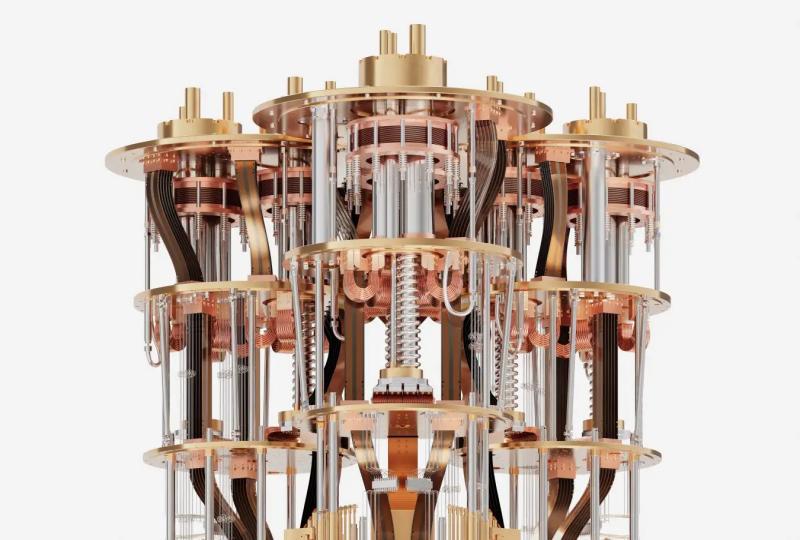
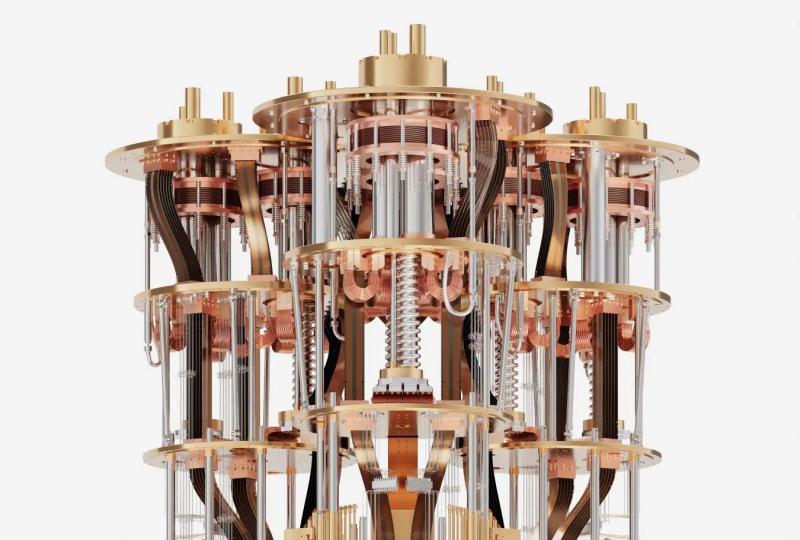
Because qubits are fragile, they are kept at millikelvin temperatures inside dilution refrigerators and shielded from electromagnetic noise. Operations are controlled with microwave pulses, and the readout is done via resonators coupled to the qubits.
Different physical platforms implement qubits in different ways: trapped ions, neutral atoms, photonics, and superconducting circuits. The last is the one most similar to today's chip manufacturing, which is a key reason it has become the dominant route for scaling to hundreds and thousands of qubits.
Superconducting qubits: From physics to microchip
A superconducting qubit is essentially an artificial atom built from electrical components:
-
Inductors and capacitors that form an LC resonator.
-
A Josephson junction, a thin insulating barrier between two superconducting materials, which introduces the nonlinearity needed to create discrete quantum energy levels that behave like a two-level system.
By tuning the geometry and materials of these circuits, engineers can design qubits with desired frequencies, coherence times, and coupling strengths. The most common types include transmon and flux-tunable qubits, which are designed to be relatively robust against charge and flux noise.
How superconducting qubits are manufactured
Superconducting qubit manufacturing looks surprisingly similar to classical semiconductor fabrication, but with extreme demands for material purity, geometric precision, and low-noise environments. Typical steps include:
Substrate and material selection
-
Wafers made of silicon, sapphire, or other low-loss dielectrics are used as the base.
-
Superconducting metals such as aluminum or niobium are deposited to form the circuit traces.
Patterning and lithography
-
Electron-beam lithography defines the nanoscale features of the qubit and Josephson junctions, often with resolutions below 100 nm.
-
This stage is critical: small variations in junction size or thickness change the qubit's frequency and coherence properties.
Josephson-junction fabrication
-
A thin oxide barrier (often aluminum oxide) is grown between superconducting layers using oxidation or deposition techniques.
-
The junction acts as the nonlinear heart of the qubit, enabling controlled anharmonicity and quantum behavior.
Etching, deposition, and capping
-
Superconducting and dielectric layers are selectively etched or deposited to form control lines, readout resonators, and shielding structures.
-
CMOS-compatible processes are being explored to co-integrate classical control electronics on the same or nearby chips.
Cool-down, calibration, and measurement
-
The finished chip is wire-bonded and mounted inside a dilution refrigerator at ~10–20 mK.
-
Engineers then calibrate qubit frequencies, gate pulses, and readout parameters on a device-specific basis.
Why manufacturing matters for scaling quantum computers
The unit cell of a quantum computer is not just a single qubit; it is a qubit plus its control lines, couplers, and readout circuit. To scale to large processors, superconducting qubit manufacturing must:
-
Deliver high yield and uniformity across hundreds or thousands of qubits.
-
Minimize material defects and surface losses that kill coherence.
-
Integrate classical control and packaging efficiently to avoid a wiring bottleneck.
Leading companies and research groups are now treating superconducting-qubit fabrication as a materials- and process-engineering discipline, very much like the development of advanced CMOS nodes for classical chips. Investment in clean-room tooling, tight process control, and standardized design kits is what will ultimately bring fault-tolerant quantum computers closer to reality.
Looking ahead: Superconducting qubits as the workhorse
Superconducting-based quantum processors already power many of the Noisy Intermediate-Scale Quantum (NISQ) devices deployed today, As qubit counts rise and error-correction codes mature, the underlying manufacturing stack will become a key differentiator—just as foundry capability is today for AI and HPC chips.
For hardware engineers and investors, the message is clear: superconducting qubit manufacturing is not just a physics experiment—it is the emerging semiconductor-like backbone of the quantum computing industry.
Featured Content