
What a Quantum Super Computer Can Do
2026.06.03 · Blog quantum super computer
Defining the Quantum Super Computer
The term “quantum super computer” is often used informally to describe a quantum system that achieves performance beyond what classical supercomputers can realistically match for certain tasks. In practice, this idea is closely related to concepts such as quantum advantage or quantum supremacy, where a quantum processor completes a computation that would be impractical for classical machines. While no single system solves all problems faster, specific workloads can demonstrate dramatic speedups.
Superconducting quantum processors have been at the center of several landmark demonstrations, where medium‑scale devices executed complex sampling tasks significantly faster than estimated classical simulations. These experiments highlight the potential of quantum systems to act as specialized accelerators rather than universal replacements for classical supercomputers. Our superconducting quantum platforms are designed with this accelerator model in mind, focusing on tasks and architectures where quantum hardware offers a clear advantage.
Superconducting Qubits as the Engine
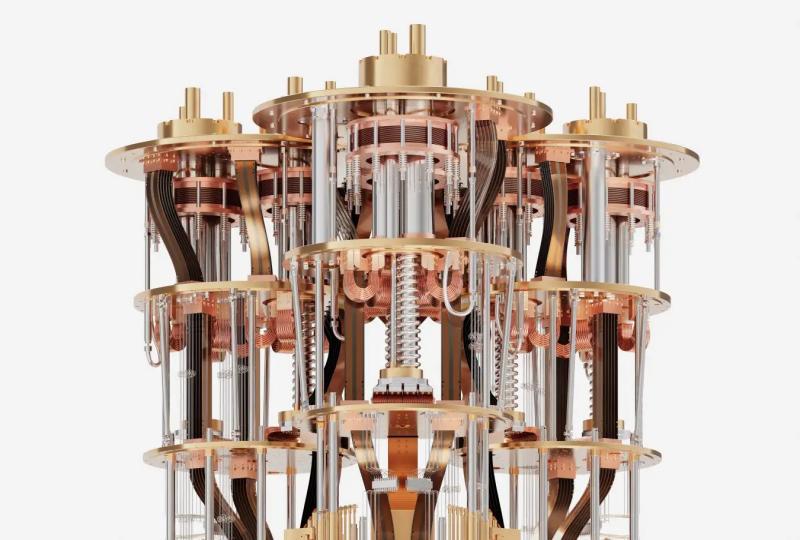
In many potential “quantum super computer” architectures, superconducting qubits play a central role. These qubits are implemented as superconducting circuits operating at cryogenic temperatures, where they can exhibit coherent quantum behavior. The use of Josephson junctions gives rise to non‑linear dynamics that enable controlled quantum operations through microwave pulses.
Over time, improvements in coherence, gate fidelity, and system engineering have made superconducting platforms one of the most advanced options for large‑scale quantum processors. Our systems build on this progress by integrating high‑quality qubit chips with robust control electronics and cryogenic infrastructure. The result is a scalable platform that can be tuned and upgraded as technology advances, paving the way toward increasingly powerful quantum accelerators.
From Demonstrations to Practical Applications
Early demonstrations of quantum advantage focused on benchmark tasks that are idealized but not directly tied to practical applications. However, ongoing research is progressively targeting more meaningful workloads in areas such as optimization, quantum chemistry, and materials modeling. As algorithms and error‑mitigation techniques improve, superconducting systems are expected to play a significant role in these domains.
We continuously refine our superconducting quantum computer solutions to support such application‑oriented workflows, including providing high‑level software interfaces, integration with classical computing environments, and tools for managing hybrid algorithms.This includes providing high‑level software interfaces, integration with classical computing environments, and tools for managing hybrid algorithms that combine quantum and classical resources. In this way, we help users move from proof‑of‑concept experiments toward application scenarios that resemble the promises associated with a “quantum super computer.”
System Architecture: Quantum Meets Classical
A realistic quantum super computer is not purely quantum; it is a hybrid system where quantum processors and classical infrastructure work together. Quantum circuits are compiled, scheduled, and interpreted by classical controllers, while results are post‑processed and fed into larger workflows. Superconducting systems are well suited to this hybrid architecture because they can be tightly integrated with classical electronics and networks.
Our solutions follow this paradigm by offering modular superconducting quantum processors connected to classical control racks, orchestration software, and integration interfaces. This modularity allows organizations to scale capacity by adding quantum modules to existing high‑performance computing environments. It also enables incremental upgrades, so users can adopt new generations of quantum chips without overhauling their entire infrastructure.
Practical Considerations: Reliability and Operation
Achieving the capabilities associated with a “quantum super computer” requires more than raw qubit numbers. Reliability, uptime, calibration speed, and operational workflows all matter. Superconducting quantum systems must maintain stable conditions over long periods, with automated procedures for calibration, monitoring, and fault detection. These operational aspects determine whether a system can be used regularly for real research and development activities.
We design our superconducting quantum computers with industrial‑grade reliability in mind, integrating cryogenic deployment solutions, robust control hardware, and monitoring tools. Our goal is to provide a quantum system that behaves as a dependable infrastructure component rather than a fragile laboratory experiment. This approach helps organizations treat quantum resources as part of their broader computing strategy, aligned with the expectations they have for advanced classical systems.
Our Role in the Quantum Super Computing Journey
The journey toward fully realized quantum super computers is ongoing, with many technical milestones still ahead. Nevertheless, practical steps can be taken today by building scalable superconducting quantum systems, validating them through benchmarks, and exploring targeted applications. We position our offerings as platforms that let users participate in this journey, from early experimentation to more advanced deployments.
By collaborating with research institutions, enterprises, and national initiatives, we help define realistic expectations for quantum performance and explore concrete use cases. Our focus on full‑stack solutions—spanning chips, control, deployment, and software—ensures that customers can engage with quantum technology at the depth that matches their goals. In doing so, we contribute to turning the idea of a “quantum super computer” into a progressively more tangible reality.
Featured Content