
Quantum Computing Explained in Simple Terms: A Complete Beginner's Guide (2026)
2026.03.13 · Blog explain quantum computing in simple terms
Quantum computing sounds intimidating, but the core idea is surprisingly straightforward: it is a new type of computing that harnesses the laws of quantum physics to solve problems that ordinary computers simply cannot. While your laptop processes information one bit at a time — either a 0 or a 1 — a quantum computer can process enormous combinations of 0s and 1s simultaneously, opening the door to breakthroughs in medicine, finance, artificial intelligence, and beyond.
This guide breaks down everything you need to know about quantum computing in plain language, from the fundamental concepts to real-world applications and how companies like SpinQ are making this powerful technology accessible to schools, universities, and industries worldwide.
What Is Quantum Computing?
A quantum computer is a machine that uses the principles of quantum mechanics — the branch of physics that governs the behavior of particles at the atomic and subatomic scale — to perform calculations. Unlike classical computers, which are built on transistors that represent data as binary bits (0 or 1), quantum computers use quantum bits (qubits) that can exist in multiple states at the same time.
Think of it this way: a classical bit is like a light switch — it is either ON (1) or OFF (0). A qubit is like a spinning coin that is simultaneously heads and tails until it lands. This ability to occupy multiple states at once is what gives quantum computers their extraordinary speed and power for certain types of problems.
The Three Core Concepts You Need to Know
Qubits: The Building Blocks
A qubit is the quantum equivalent of a classical bit. What makes qubits special is that they are built from real quantum physical systems — such as the nuclear spins of atoms or superconducting electrical circuits — that obey quantum mechanical rules. SpinQ's NMR (Nuclear Magnetic Resonance) quantum computers, for example, use nuclear spins as qubits, which are manipulated and read through radio frequency (RF) pulses.
Superposition: Being in Two Places at Once
Superposition means a qubit can be in the state 0, the state 1, or any combination of both at the same time. When you have 2 qubits, you can represent 4 states simultaneously; with 3 qubits, 8 states; and the number doubles with every additional qubit. This exponential scaling is precisely what gives quantum computers their computational advantage for certain tasks.
Entanglement: Quantum Teamwork
Quantum entanglement is when two or more qubits become linked together so that the state of one instantly influences the state of the other, regardless of the distance between them. Entanglement allows quantum computers to coordinate information across qubits in ways that classical computers cannot replicate, enabling massively parallel computation.
Quantum vs. Classical Computing: A Side-by-Side Look
| Feature | Classical Computer | Quantum Computer |
| Basic unit of data | Bit (0 or 1) | Qubit (0, 1, or superposition) |
| Processing style | Sequential / parallel (limited) | Quantum parallelism |
| Speed advantage | General everyday tasks | Complex optimization & simulation |
| Size | Desktop / handheld | Lab-scale to desktop (e.g., SpinQ Gemini) |
| Maintenance | None required | Varies (NMR: maintenance-free; superconducting: ultra-cold) |
| Cost | Hundreds to thousands of USD | Thousands to millions of USD |
| Best use case | Word processing, web browsing | Drug discovery, AI, finance, cryptography |
How Does a Quantum Computer Actually Work?
At the heart of every quantum computer is a system for initializing, manipulating, and measuring qubits. Here is the basic workflow:
-
Initialize — Qubits are set to a known starting state (typically all 0s).
-
Apply quantum gates — These are the quantum equivalent of logic gates in classical computing. They manipulate the qubits through superposition and entanglement to perform calculations.
-
Measure — Reading the qubit collapses its superposition into a definite 0 or 1. The results are probabilistic, so quantum algorithms are designed to amplify the probability of the correct answer.
-
Repeat and analyze — Because of the probabilistic nature, calculations are often run many times (called "shots") to obtain reliable results.
SpinQ's desktop NMR quantum computers, for instance, use RF pulse technology to control nuclear spins through this exact process, with the hardware managing everything from pulse generation to signal readout.
Types of Quantum Computing Technologies
Different physical systems are used to build quantum computers, each with its own trade-offs:
| Technology | How It Works | Key Advantage | Example |
| NMR (Nuclear Magnetic Resonance) | Uses nuclear spins as qubits, controlled by RF pulses | Room-temperature operation, stable, maintenance-free | SpinQ Gemini, SpinQ Triangulum |
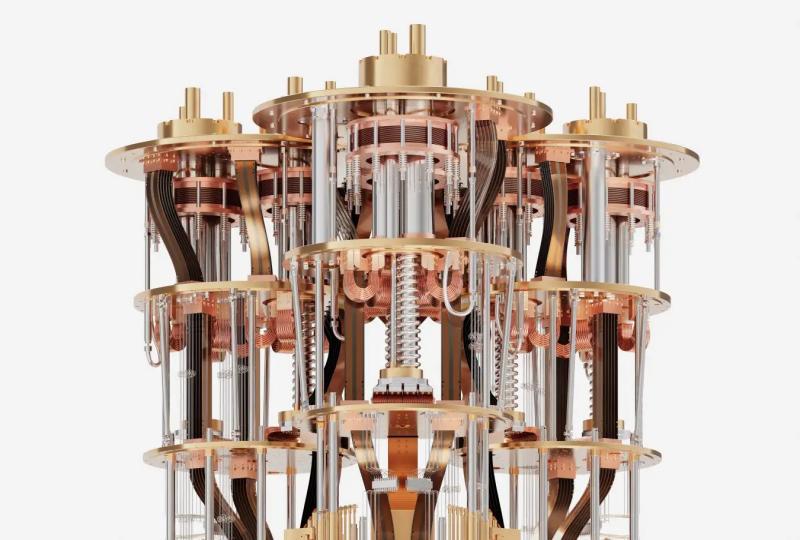
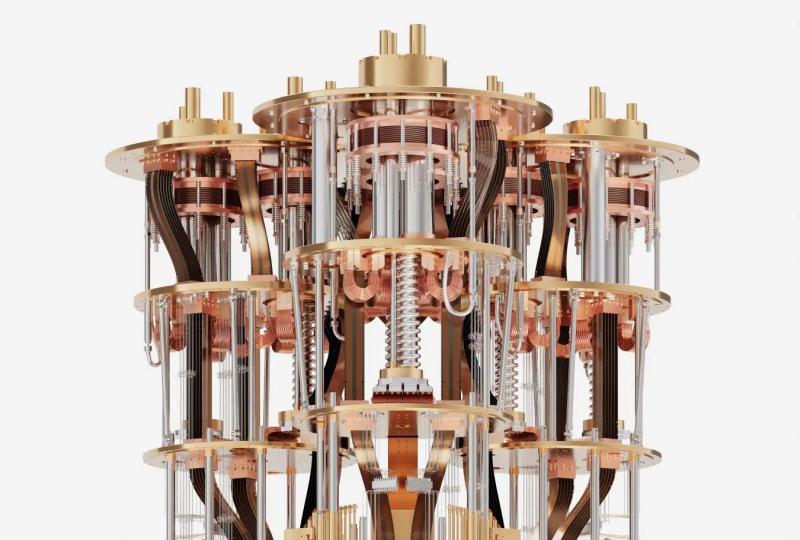
| Superconducting | Uses Josephson junction circuits near absolute zero | Scalable, fast gate times (nanoseconds) | SpinQ SQC, IBM, Google |
| Trapped Ions | Ions suspended by electromagnetic fields | Long coherence times, high fidelity | IonQ, Honeywell |
| Photonic | Uses photons (light particles) as qubits | Works at room temperature | PsiQuantum |
SpinQ's superconducting quantum computers operate near 20 millikelvin (about -273°C) and achieve single-qubit gate fidelity of up to 99.9%, while their NMR systems operate at room temperature and are completely maintenance-free — a major advantage for educational settings.
Real-World Applications of Quantum Computing
Quantum computing is already finding practical applications across industries:
-
Drug Discovery & Healthcare — Quantum computers can simulate molecular interactions at the quantum level, dramatically accelerating the development of new medicines. BGI Research, for example, partnered with SpinQ to tackle genome assembly challenges using quantum algorithms.
-
Financial Technology — Quantum computing enables faster portfolio optimization, risk modeling, credit analysis, and fraud detection. Huaxia Bank used SpinQ's quantum AI model to intelligently manage ATM machine operations and won the First Prize of the 2020 Financial Technology Development Award from China's People's Bank.
-
Artificial Intelligence — Quantum machine learning algorithms can exponentially accelerate text classification, recommendation systems, and sentiment analysis.
-
Logistics & Optimization — Quantum algorithms excel at path planning and part-selection problems in manufacturing, reducing complexity and improving efficiency.
-
Materials Science — Simulating complex molecular and material structures to engineer better batteries, solar cells, and semiconductors.
-
Climate & Energy — Modeling complex environmental systems to support climate research and new energy development.
Making Quantum Computing Accessible: The SpinQ Approach
One of the biggest barriers to quantum computing has historically been accessibility. Most quantum systems require massive infrastructure, ultra-cold environments, and highly specialized expertise. SpinQ, founded in 2018 and headquartered in Shenzhen, China, is changing that.
SpinQ launched the world's first programmable desktop NMR quantum computer — the SpinQ Gemini — and has since expanded to a full product line that spans portable 2-qubit devices all the way to 20-qubit industrial-grade superconducting systems. Their products are sold in over 30 countries across all five continents, making SpinQ the first quantum computing company to achieve global distribution on this scale.
Key products from SpinQ include:
-
SpinQ Gemini Mini / Mini Pro — A 2-qubit portable NMR quantum computer with a built-in touchscreen. Ideal for high school demonstrations and introductory university courses.
-
SpinQ Triangulum — A 3-qubit desktop NMR quantum computer supporting any 3-qubit quantum algorithm, with open hardware-level pulse editing.
-
SpinQ Gemini Lab — A 13-qubit one-stop experimental platform covering everything from pulse-level to algorithm-level experiments, designed for university research and teaching.
-
SpinQ SQC (Superconducting Quantum Computer) — A 20-qubit industrial-grade system for complex research in quantum chemistry, materials science, and quantum finance.
-
SpinQ Cloud — A cloud platform connecting NMR and superconducting quantum computers of 2, 3, 5, and 8 qubits, plus a 24-qubit full-amplitude simulator, accessible online.
-
SpinQit — A Python-based quantum programming framework compatible with OpenQASM 2.0 and Qiskit, supporting cross-platform execution on real hardware, simulators, and the SpinQ cloud.
Quantum Computing in Education
Quantum literacy is increasingly seen as a critical 21st-century skill. SpinQ has developed comprehensive quantum education solutions for both K-12 and university levels, combining real quantum hardware with structured curricula.
Universities including MIT, the University of Waterloo, the University of Tokyo, Oslo Metropolitan University, and the University of Western Australia have adopted SpinQ's quantum computers for hands-on teaching and research. At the high school level, institutions like Shenzhen Middle School and Shenzhen Gezhi Academy have introduced SpinQ's portable quantum computers into their curricula, giving students direct experience with real quantum hardware for the first time.
Quantum Computing Challenges
Despite all the excitement, quantum computing is still maturing. Key challenges include:
-
Decoherence — Qubits are extremely fragile. Any interaction with the environment can cause them to lose their quantum state. Minimizing decoherence is one of the field's biggest engineering challenges.
-
Error rates — Quantum gates are not perfect. Error correction techniques exist but require significant overhead in additional qubits.
-
Scalability — Building systems with thousands or millions of reliable qubits remains an open engineering problem.
-
Accessibility and cost — High-performance quantum computers remain expensive, though companies like SpinQ are dramatically lowering the entry point.
FAQs About Quantum Computing
Q: Do I need to know advanced math to use a quantum computer?
Not necessarily. SpinQ's educational products include graphical programming interfaces and built-in curricula, making it possible for high school students and beginners with only a basic background in math to run real quantum algorithms.
Q: How many qubits do you need to do something useful?
It depends on the task. Even 2–3 qubits, as found in SpinQ's portable NMR computers, are sufficient for learning foundational quantum algorithms like Deutsch-Jozsa, Grover's algorithm, and quantum Fourier transforms. Industrial applications like quantum chemistry simulations typically require 10–20+ qubits.
Q: Will quantum computers replace classical computers?
No — at least not anytime soon. Quantum computers excel at specific types of problems (optimization, simulation, cryptography) but are not suited for everyday tasks like browsing the web or writing documents. The future most likely involves hybrid classical-quantum computing, where each type of processor handles what it does best.
Q: What programming language is used for quantum computing?
Most quantum programming today is done in Python-based frameworks. SpinQ's SpinQit framework uses Python and is also compatible with OpenQASM 2.0 and Qiskit, enabling users to run programs on NMR computers, superconducting systems, simulators, and cloud platforms all from one interface.
Q: Can I access a real quantum computer right now? Yes. SpinQ's cloud platform SpinQ Cloud provides online access to real NMR quantum computers (2, 3, 5 qubits) and superconducting systems (8 qubits), along with a 24-qubit simulator, without needing to own any hardware.
Q: Is quantum computing safe for encryption?
This is a nuanced issue. Future large-scale quantum computers could potentially break current encryption standards (like RSA), which is why the field of post-quantum cryptography is actively developing new encryption methods designed to be secure even against quantum attacks.
The Quantum Future Is Now
Quantum computing is no longer a distant theoretical concept locked away in physics laboratories. With companies like SpinQ making real quantum hardware available at the desktop and portable level — for use in high schools, universities, research labs, and commercial settings — quantum computing is transitioning from a research curiosity to a practical technology. Whether you're a student, educator, researcher, or business professional, now is the time to start understanding and engaging with this transformative technology.
Featured Content