
Inside Quantum Computer Manufacture: From Design to Deployment
2026.06.30 · Blog quantum computer manufacture
From Lab Prototype to Manufactured System
The phrase “quantum computer manufacture” sounds straightforward, but behind it there is an entire chain of disciplines and facilities.
Early quantum devices were hand‑assembled experimental setups in physics labs. Turning that into a repeatable manufacturing process is a completely different challenge.
Modern quantum computer manufacture has to combine micro‑ and nano‑fabrication, precision cryogenics, high‑frequency electronics, and reliable software stacks into one coherent product.
It also has to deliver the same performance not just once, but across many systems shipped to research labs and institutions around the world.
Designing the Quantum Processor
At the heart of the system is the quantum processor, often called the QPU (quantum processing unit).
For superconducting platforms, this means designing superconducting qubit circuits on a chip: transmons, couplers, resonators, control lines, and readout structures.
The design process looks more like advanced RF and microwave engineering than traditional digital chip design.
Engineers simulate electromagnetic behavior, optimize chip layouts for coherence, and consider how packaging, cabling, and filters will affect performance.
Because the field is still young, the design process is iterative. Teams fabricate small test chips, measure them, refine the design, and then scale up to larger processor layouts.
This feedback loop is central to quantum computer manufacture: it’s not just about making more chips, but about making better chips with every generation.
Fabrication and Quality Control
Once a design is ready, the manufacturing process moves into the fabrication stage.
Quantum processors require specialized materials, cleanroom environments, and carefully controlled processes such as thin‑film deposition, lithography, and etching.
Yield is a major consideration. A single processor might contain dozens or hundreds of qubits, each with its own structures and interfaces.
Tiny variations in fabrication can affect coherence times or gate behavior. That’s why quantum manufacturers invest heavily in process control and characterization.
Quality control doesn’t end at the wafer. Individual chips are packaged, wire‑bonded or bump‑bonded, and then tested at cryogenic temperatures.
Only devices that meet defined performance thresholds make it into full systems.
Building the Cryogenic and Control Stack
A quantum processor by itself is just a sophisticated piece of metal and dielectric on a chip. To turn it into a functioning quantum computer, you need an entire environment around it.
For superconducting systems, that typically means:
-
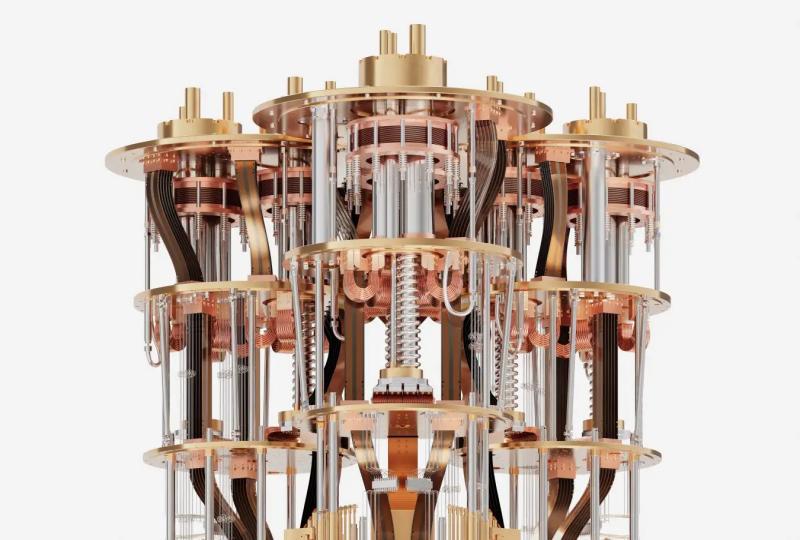
A cryogenic refrigerator that cools the chip to millikelvin temperatures
-
Shielding and filtering to protect it from noise and interference
-
Racks of control and measurement electronics to generate and read out microwave signals
-
Wiring and fixtures that connect the room‑temperature electronics to the cryogenic stage
Manufacturing quantum computers therefore includes producing and integrating all these layers.
Vendors standardize cabling, connectors, and mechanical structures so systems can be assembled consistently and serviced efficiently.
Control electronics are often modular, with dedicated units for waveform generation, readout, synchronization, and timing.
These pieces must work together with tight specifications, since even small timing or phase errors can degrade performance.
Software, Calibration, and System Bring‑Up
Even after the hardware is built, a “newborn” quantum computer does not simply power on and start running useful algorithms.
It has to be calibrated and tuned, sometimes over many days, before it performs at its full potential.
In practice, this means:
-
Mapping physical qubits and control lines
-
Measuring frequencies, anharmonicities, and cross‑talk
-
Tuning pulses for high‑fidelity gates
-
Setting up readout parameters and thresholds
Manufacturers invest in software tools that automate as much of this process as possible.
Those tools become part of the product: they allow users to recalibrate the system, monitor stability, and diagnose issues in daily operation.
From a manufacturing perspective, the ability to bring up systems quickly and reproducibly is critical.
It’s what turns a collection of complex components into a consistent product line.
Scaling from One System to Many
Another important aspect of quantum computer manufacture is scalability in production.
It is one thing to deliver a single showcase system to a partner lab. It is another to deliver multiple systems to different institutions, with consistent behavior and support.
Manufacturers standardize:
-
Mechanical and electrical interfaces
-
Rack layouts and footprint
-
Control hardware configurations
-
Remote monitoring and diagnostic tools
This standardization makes it possible to train support teams, maintain spare parts, and offer customers reasonable lead times.
It also allows the manufacturer to roll out improvements across systems in the field through software updates and planned hardware upgrades.
Collaboration with Users and Ecosystem
Quantum computer manufacture is tightly connected to the user community.
Feedback from researchers, educators, and early industrial users shapes the priorities for each generation of hardware.
Manufacturers often run joint projects with key customers to explore new applications, test advanced features, or validate system upgrades.
Those collaborations help translate raw hardware capability into real‑world use.
In a young field like quantum computing, that feedback loop is as important as any production line.
The best manufacturing processes are built not just around machines and materials, but around relationships and shared goals.

Featured Content