
Superconducting Quantum Computing: Why It Leads Today’s Race
2026.07.01 · Blog superconducting quantum computing
What Superconducting Quantum Computing Actually Is
Superconducting quantum computing is a hardware approach where qubits are built from tiny superconducting circuits, cooled to extremely low temperatures so that they behave quantum mechanically. Instead of using natural atoms or ions floating in a trap, engineers pattern “artificial atoms” on a chip using Josephson junctions, resonators, and carefully designed metal traces.
When these circuits are cooled close to absolute zero, they lose electrical resistance and start to exhibit quantum behavior that we can control. A single circuit can act like a qubit with two main energy levels and additional higher levels in the background. By sending in microwave pulses, we can drive transitions between those levels, create superpositions, and entangle multiple qubits across the chip.
That is the basic idea behind superconducting quantum computing: use familiar fabrication techniques to build quantum objects directly on a chip, then integrate them into a larger controlled system.
Why Superconducting Platforms Pulled Ahead
Over roughly the last decade and a half, superconducting quantum computing has moved from fragile lab experiments to something that looks and feels like an engineered product. Major technology companies, national labs, and specialized quantum firms have put large teams behind this platform, and that investment has paid off.
Today, superconducting systems offer:
-
Processors with tens to hundreds of physical qubits
-
Coherence times that are long enough for meaningful algorithms and experiments
-
Gate fidelities that keep inching closer to error‑corrected regimes
-
Mature cryogenic and control ecosystems that can be replicated at multiple sites
-
Software stacks and cloud access that are usable by people who are not hardware experts
Does that mean other platforms are irrelevant? Not at all. Trapped‑ion, neutral‑atom, photonic, and spin‑based systems are all making progress and may lead in certain niches. But superconducting technology has become the reference point that many people compare others against, because it has repeatedly demonstrated the ability to scale, integrate, and ship.
Inside a Superconducting Quantum Processor
If you zoom into a superconducting quantum chip, you don’t see transistors in the classical sense. Instead, you see patterns of metal that form capacitors, inductors, and Josephson junctions. These structures combine to create nonlinear oscillators that act as qubits.
A typical processor includes:
-
Qubits (often transmons) laid out on a planar chip
-
Couplers that connect pairs or small groups of qubits
-
Readout resonators that let you measure qubit states
-
Feed lines that deliver microwave control signals
-
Ground planes and shielding structures to reduce unwanted modes
The geometry of these elements is not arbitrary. It determines how qubits interact, which two‑qubit gates are available, and how sensitively the device responds to noise. Designers simulate electromagnetic behavior and optimize patterns to strike a balance between connectivity, coherence, and ease of control.
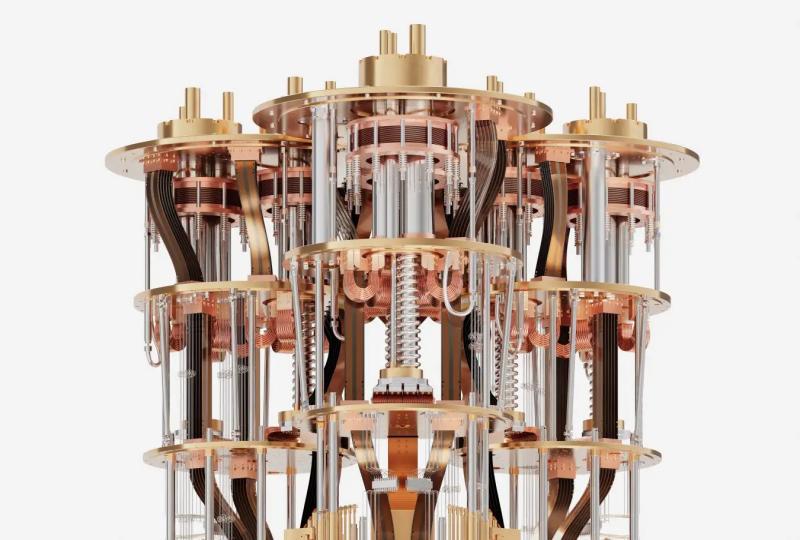
Once fabricated, the chip is packaged, cooled down in a dilution refrigerator, and connected to racks of room‑temperature electronics. Only then does it become a functioning quantum processor.
The Full Stack: More Than Just the Chip
One common misunderstanding is to think of superconducting quantum computing as “just the chip.” The chip is crucial, of course, but the full system is a stack of interdependent layers:
-
Cryogenic infrastructure that keeps the chip at millikelvin temperatures
-
Filtering and shielding to keep out thermal noise and electromagnetic interference
-
Control hardware: arbitrary waveform generators, RF sources, digitizers, and timing modules
-
Classical control software to coordinate pulses, measurements, and feedback
-
Compiler, runtime, and API layers that turn user code into physical operations
-
Front‑end tools such as Python SDKs, web interfaces, and cloud portals
When all these layers are well integrated, a researcher can write a program in a high‑level language, submit it, and receive results without manually worrying about each cable and filter. When they are not well integrated, users feel the friction immediately: fragile setups, long calibration times, inconsistent results.
This is where the most mature superconducting platforms distinguish themselves. They treat the entire stack as a product, not as an afterthought.
Where Superconducting Quantum Computing Is Used Today
Superconducting systems have found a home in several distinct communities.
National labs use them to test quantum error‑correction schemes, explore multi‑qubit physics, and benchmark algorithm performance. For those users, access to low‑level controls, detailed diagnostics, and the ability to modify firmware can be as important as qubit count.
Universities deploy superconducting platforms for both research and advanced teaching. Graduate students might use cloud‑hosted systems to implement new algorithms, while specialized programs install local hardware to build expertise in cryogenics and control.
Industry teams usually start with cloud access to superconducting quantum computers rather than buying their own hardware. They explore use cases in optimization, materials modeling, finance, and machine learning, often in the form of small proof‑of‑concept projects. Over time, some organizations move toward closer partnerships or on‑premises deployments when they need deep integration with internal systems.
Across all of these groups, the common thread is that superconducting platforms are the default choice when people talk about “running on real hardware” today.
Key Challenges the Field Is Tackling
Despite the progress, superconducting quantum computing still faces serious hurdles. It’s important to be honest about them rather than pretending everything is solved.
First, error rates are still too high to run deeply complex algorithms without some combination of error mitigation and error correction. Error‑correcting codes require many physical qubits to build a single logical qubit, so increasing qubit numbers and improving quality remain central goals.
Second, engineering complexity is non‑trivial. Building and maintaining dilution refrigerators, high‑frequency electronics, and dense cabling is not something every institution can or wants to do on its own. This is one reason why cloud access and turnkey systems are so important.
Third, software and applications are still catching up. While we have a growing library of algorithms and techniques, many real‑world use cases remain in the exploratory phase. Finding the problems where superconducting quantum computing can deliver clear advantages is an ongoing research task.
The field is tackling these challenges head‑on with better chip designs, more sophisticated calibration routines, smarter compilers, and deeper integration with classical HPC resources.
What This Means for the Future
Looking ahead, superconducting quantum computing is likely to remain a central pillar of the quantum effort. It already has a track record of regular hardware improvements, and it benefits from supply chains and engineering cultures inherited from the semiconductor and RF industries.
In practical terms, we can expect:
-
Larger devices with more consistent qubit quality across the chip
-
Better control over noise and cross‑talk
-
More automation in calibration and system management
-
Tighter integration with cloud and on‑premises classical infrastructure
-
A gradual shift from one‑off experiments to routine workflows
For researchers, that means more stable platforms on which to test ideas. For educators, it means more accessible ways to expose students to real devices. For industry, it opens the door to carefully chosen pilot projects where quantum can complement existing tools rather than trying to replace them.
Superconducting quantum computing is not the only game in town, but it is currently one of the clearest routes from the physics lab to deployed quantum systems.
Featured Content