
Enterprise Superconducting Quantum Computers: The Complete Guide for Technology Leaders
2026.05.21 · Blog enterprise superconducting quantum computer
The quantum computing industry crossed a defining threshold in 2025. After decades of laboratory research, enterprise superconducting quantum computers are now being procured, deployed, and integrated into real workflows by pharmaceutical companies, financial institutions, national laboratories, and technology enterprises worldwide. The global quantum computing market reached between USD 1.8 billion and USD 3.5 billion in 2025, with projections reaching USD 20.2 billion by 2030 at a CAGR of 41.8% — positioning it as one of the fastest-growing technology sectors of the decade.
For enterprise technology leaders — CTOs, research directors, and quantum strategy teams — the question has shifted from "should we pay attention to quantum computing?" to "what exactly should we deploy, when, and how?" This guide answers all three.
What Makes a Superconducting Quantum Computer "Enterprise-Grade"?
Not all quantum computers are created equal. The term enterprise superconducting quantum computer describes a specific tier of hardware: systems engineered not for laboratory demonstration, but for sustained, reliable, high-fidelity operation in demanding research and commercial environments.
Enterprise-grade distinguishes itself from research-prototype hardware along five dimensions:
| Dimension | Research Prototype | Enterprise System |
| Qubit count | 5–20 qubits | 50–100+ qubits |
| Gate fidelity | >95% | >99% (target >99.9%) |
| Uptime | Best-effort | SLA-backed |
| Software integration | Manual calibration | Automated calibration + API |
| Support | Academic | Vendor engineering support |
SpinQ Technology's SPINQ SQC superconducting quantum computer is designed precisely at this enterprise tier — supporting up to 103 superconducting qubits with parametric gate support, quantum error correction, long coherence times, and high gate fidelity — built for biopharmaceutical research, materials science, FinTech, and AI applications.
How Enterprise Superconducting Quantum Computers Work
Understanding the technology at an enterprise level means knowing enough physics to evaluate vendor claims — without needing a PhD in condensed matter physics.
The Qubit: A Fundamentally Different Information Unit
Classical enterprise servers store and process information as binary bits — 0 or 1. A qubit exploits quantum mechanics to exist in a superposition of both states simultaneously, represented as:
∣ψ⟩=α∣0⟩+β∣1⟩∣ψ⟩=α∣0⟩+β∣1⟩
The computational consequence is profound: a register of nn qubits spans 2n2n states simultaneously. A 100-qubit enterprise system accesses a state space of 10301030 — a number that exceeds the atoms in the observable universe and is completely unreachable by any classical system regardless of how many processors are added.
The Josephson Junction: The Core Physical Component
Superconducting qubits are built around Josephson junctions — nanometer-thin insulating barriers between two superconducting materials through which electron pairs tunnel quantum mechanically. This tunneling creates a non-linear inductance that gives the circuit a uniquely anharmonic energy structure, allowing microwave pulses to selectively address qubit transitions.
The 2025 Nobel Prize in Physics was awarded for this exact discovery: "macroscopic quantum mechanical tunneling and energy quantization in an electric circuit" — validating the physical foundation of every enterprise superconducting quantum computer deployed today.
Cryogenic Operation at 10–20 Millikelvin
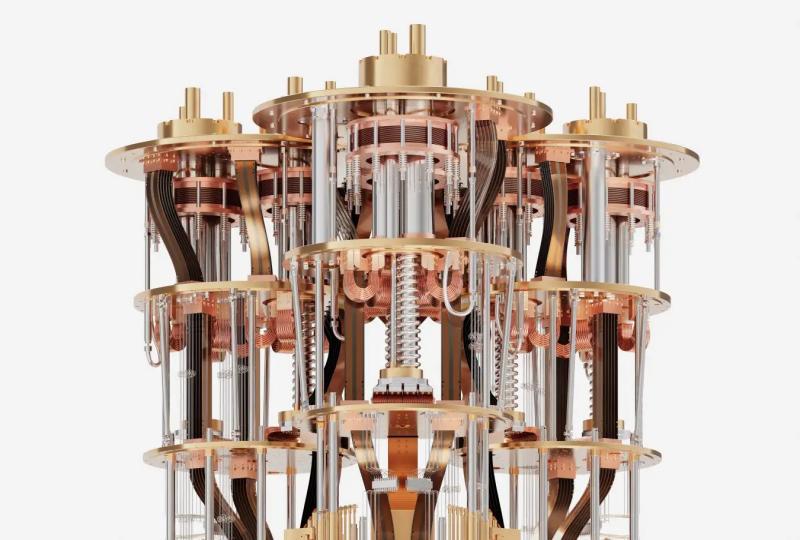
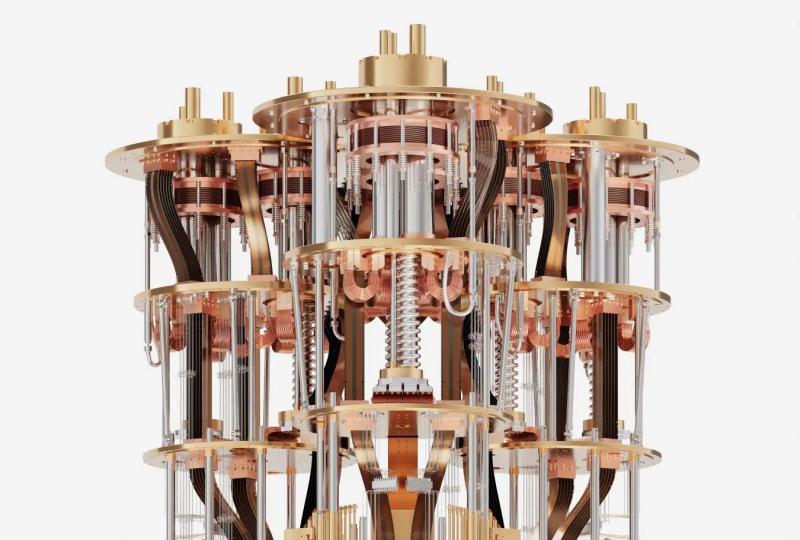
All superconducting qubits must operate inside dilution refrigerators at approximately 10–20 millikelvin — colder than deep space. This is not an engineering quirk but a physical necessity: thermal photons at room temperature carry enough energy to flip qubit states thousands of times per second, making quantum computation impossible without cryogenic isolation.
For enterprises, this means the dilution refrigerator is a critical infrastructure component requiring specialist management. SpinQ's Cryogenic Environment Deployment Services address this directly, providing end-to-end selection, installation, and lifecycle maintenance of dilution refrigerators to deliver turnkey ~10 mK operating environments.
Microwave Control: Gate Operations and Readout
Quantum computations are executed by applying precisely calibrated microwave pulses at qubit resonant frequencies (typically 4–8 GHz). Each pulse implements a quantum gate operation — a rotation on the qubit's state space. Two-qubit gates create entanglement between qubits, enabling the coordinated multi-qubit operations that quantum algorithms require.
This microwave control layer is managed by the Quantum Control and Measurement (QCM) system — the classical electronics that translate software commands into quantum hardware operations. The QCM's precision directly determines whether a system achieves 99% or 99.9% gate fidelity, making it one of the most performance-critical components in an enterprise quantum stack. SpinQ's SPINQ QCM System, with FPGA-based edge computing, sub-nanosecond synchronization, and up to 16-bit amplitude resolution, is engineered for exactly this enterprise requirement.
The Enterprise Quantum Advantage: Where It Actually Applies
Enterprise leaders need honest answers about where quantum advantage is real today, where it is emerging, and where it remains theoretical. Here is the current state across the highest-value enterprise domains:
Drug Discovery and Molecular Simulation — Proven Value, Expanding Fast
Status: Active enterprise deployments. Classical computers cannot accurately simulate the quantum behavior of molecules beyond modest size — the computational cost scales exponentially with the number of electrons involved. This limitation directly causes pharmaceutical R&D waste: billions spent on drug candidates that fail in late-stage trials due to poorly predicted molecular behavior.
Enterprise quantum computers address this at the physics level. Google and Boehringer Ingelheim have demonstrated quantum simulation of Cytochrome P450 — a key enzyme in drug metabolism — with greater precision than classical methods. SpinQ and BGI-Research have an active partnership applying quantum computing to genomics, using variational quantum algorithms to optimize genome assembly.
Enterprise timeline: Hybrid quantum-classical molecular simulation tools are deployable today for research groups with 50+ qubit hardware. Full quantum advantage in large-molecule simulation is projected within 3–5 years as error-corrected qubit counts scale.
Financial Services — Portfolio Optimization and Risk Modeling
Status: Pilot deployments delivering measurable results. Portfolio optimization, derivatives pricing, and real-time risk analysis involve combinatorial search spaces that grow exponentially with assets and constraints. Classical Monte Carlo simulations — the industry standard — require approximations that introduce systematic errors.
JPMorgan Chase partnered with IBM to explore quantum algorithms for option pricing and risk analysis, with early studies indicating quantum models could outperform classical Monte Carlo in both speed and scalability. SpinQ partnered with Longying Zhida (Huaxia Bank subsidiary) to develop a quantum neural network model supporting ATM removal decisions — a direct enterprise deployment in commercial banking digital transformation.
Enterprise timeline: Quantum-enhanced optimization for financial modeling is viable now for forward-looking research teams. Commercially significant advantages are projected within 2–4 years as hardware and algorithm maturity converge.
Manufacturing and Logistics — Optimization at Scale
Status: Early production pilots, strong near-term outlook. Route optimization, supply chain scheduling, and manufacturing design involve NP-hard combinatorial problems where classical methods rely on heuristics that miss the true optimum. As system complexity grows, the quality of classical solutions degrades.
Volkswagen deployed quantum algorithms for taxi dispatch route optimization in Beijing, reducing travel times and congestion. Airbus is researching quantum optimization for aircraft wing design. DHL has run pilots on warehouse picking routes and logistics scheduling.
Enterprise timeline: Quantum optimization pilots are viable today for enterprises with in-house quantum teams. Production-scale quantum optimization advantage is projected within 3–5 years.
Cybersecurity — The Urgent Defensive Priority
Status: Deployment-critical now. This is the domain where enterprises cannot afford to wait. RSA and elliptic-curve cryptography — the foundation of enterprise network security — are vulnerable to Shor's algorithm on fault-tolerant quantum computers. Security experts warn that adversaries are harvesting encrypted data today for future decryption ("harvest now, decrypt later").
NIST finalized its first post-quantum cryptography standards in August 2024: ML-KEM, ML-DSA, and SLH-DSA — ready for immediate enterprise implementation. The White House has initiated executive actions accelerating federal agency migration to post-quantum standards.
Enterprise timeline: Post-quantum cryptography migration is a current, urgent enterprise priority regardless of quantum hardware deployment decisions. Quantum Key Distribution (QKD) infrastructure is deployable today for highest-sensitivity enterprise communications.
The Enterprise Quantum Technology Stack
Deploying an enterprise superconducting quantum computer is not a single hardware decision — it is a stack decision. Enterprise leaders should evaluate every layer:
Layer 1: Quantum Processing Unit (QPU)
The superconducting qubit chip that performs quantum computation. Key evaluation criteria: qubit count, gate fidelity (single and two-qubit), coherence time (T₁ and T₂), qubit connectivity topology, and parametric gate support.
SpinQ's QPU C Series — including the C10, C25, and C103 models — are designed and fabricated in-house with high Qi factor, extended coherence times, and excellent circuit uniformity, operating at ~20 mK.
Layer 2: Cryogenic Infrastructure
The dilution refrigerator system that maintains the QPU at operating temperature. Enterprise evaluation criteria: base temperature stability, cooling power, vibration isolation, thermal budget for control wiring, mean time between maintenance events.
SpinQ's Cryogenic Deployment Services provide complete infrastructure support — from selection and procurement through installation, commissioning, and ongoing maintenance — eliminating the specialized expertise gap that most enterprises face when deploying cryogenic systems for the first time.
Layer 3: Quantum Control and Measurement Electronics
The classical RF electronics that generate and process every microwave signal entering and exiting the cryostat. This is where software intent becomes hardware reality. Enterprise evaluation criteria: synchronization precision, noise floor, amplitude resolution, channel count, scalability, and real-time feedback capability for error correction.
SpinQ's SPINQ QCM System delivers:
-
FPGA-based distributed edge computing for real-time waveform generation and signal processing — eliminating bottlenecks and enabling error-correction feedback loops
-
Sub-nanosecond synchronization and up to 16-bit amplitude resolution across all channels — the precision foundation for >99% gate fidelity
-
Modular architecture scalable to hundreds of qubits — add units as qubit count grows, no architectural redesign required
-
Automated qubit characterization and calibration with built-in network analyzer and spectrum analysis — reducing time-to-operation from weeks to days
Full specifications and enterprise configuration options: https://www.spinquanta.com/products-services/quantum-control-and-measurement-system
Layer 4: Quantum Software and Development Tools
The framework through which enterprise developers write, compile, and execute quantum algorithms. Key criteria: programming language support (Python, Q#, Qiskit compatibility), circuit optimization, noise mitigation tools, simulator fidelity for pre-hardware testing, and hybrid quantum-classical workflow support.
SpinQ's SpinQit Python SDK and cloud platform provide access to both NMR and superconducting quantum hardware with graphical and programmatic interfaces — enabling algorithm development workflows that scale from simulation to cloud to on-premises hardware.
Layer 5: Professional Services and Support
Enterprise quantum deployment requires specialized expertise that most organizations do not have in-house. Key service components: system integration, application development support, calibration services, operator training, and ongoing engineering support.
SpinQ's QPU Foundry and Characterization Services extend this to chip-level customization — providing professional QPU design, fabrication, and characterization for enterprises building differentiated quantum capabilities, with a track record including delivering China's first independently developed superconducting quantum chip to a research institution in the Middle East.
Enterprise Quantum Readiness: A Practical Framework
Based on the current state of enterprise superconducting quantum computing, here is a maturity-based deployment framework for technology leaders:
Level 1 — Quantum Awareness (Now): Identify the 3–5 computational problems in your organization that are limited by classical exponential complexity. Assign a small team to quantum literacy. Begin post-quantum cryptography assessment immediately.
Level 2 — Quantum Experimentation (Now–12 months): Access quantum hardware via SpinQ Cloud or IBM Quantum. Run hybrid quantum-classical pilots on your identified problem domains. Develop internal algorithm expertise. Evaluate on-premises hardware requirements.
Level 3 — Quantum Research Deployment (12–24 months): Deploy an on-premises enterprise superconducting quantum system (50–103 qubits) for proprietary research. Integrate QCM control electronics and cryogenic infrastructure. Build hardware-software co-design capability for your application domain.
Level 4 — Quantum Production (24–48 months): Scale to fault-tolerant quantum operations as hardware and error correction mature. Integrate quantum workflows into production research and development pipelines. Pursue quantum advantage in target application domains.
The Enterprise Competitive Landscape in 2026
The enterprise quantum computing landscape is more competitive than ever. IBM's roadmap targets scientific quantum advantage demonstration in 2026 and fault-tolerant modules by 2027. Fujitsu and RIKEN deployed a 256-qubit superconducting system in 2025 with a 1,000-qubit system targeted for 2026. Google's Willow chip ran a benchmark algorithm 13,000 times faster than classical supercomputers.
Venture capital funding surged to over USD 2 billion in 2024 — a 50% increase from 2023 — with the first three quarters of 2025 alone attracting USD 1.25 billion, more than doubling previous year figures. JPMorgan Chase announced a USD 10 billion investment initiative specifically naming quantum computing as a strategic technology.
The talent gap is equally significant: only one qualified quantum professional exists for every three specialized positions globally, and quantum job postings have tripled since 2011. McKinsey estimates that over 250,000 new quantum professionals will be needed globally by 2030. Enterprises that begin building quantum capability now — hardware, software, and talent — compound their advantage over those that wait.
SpinQ: The Enterprise Superconducting Quantum Partner
SpinQ Technology offers the most complete enterprise superconducting quantum product portfolio from a single vendor:
-
SPINQ SQC Superconducting Quantum Computer — 103-qubit enterprise system, parametric gate support, quantum error correction, designed for biopharmaceutical, materials, FinTech, and AI applications
-
SPINQ QPU C Series — standalone superconducting chips (C10, C25, C103) for custom enterprise builds
-
SPINQ QCM System — enterprise-grade quantum control electronics, FPGA-accelerated, scalable to hundreds of qubits → Full details
-
Cryogenic Deployment Services — turnkey dilution refrigerator infrastructure
-
QPU Foundry Services — custom chip design, fabrication, and characterization
-
SpinQ Cloud — cloud access for algorithm development without capital hardware investment
The enterprise quantum era is not approaching — it has arrived. Organizations that build their quantum capabilities today will define the competitive benchmarks their industries operate against for the next decade.
Featured Content