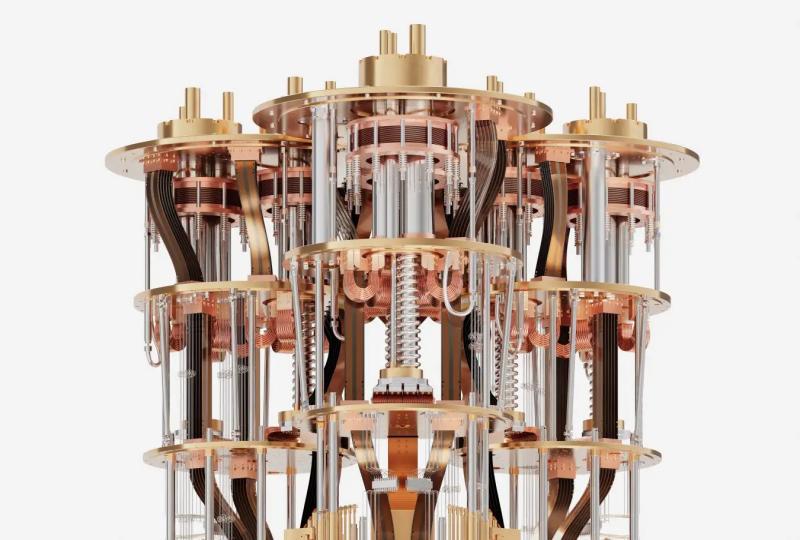

Calibration for Superconducting Quantum Computers
2026.06.18 · Blog calibration superconducting quantum computer
Why Calibration Defines Superconducting Quantum Computer Performance
Calibration is the invisible backbone of every superconducting quantum computer. Even with high‑quality chips and advanced cryogenics, a system cannot deliver stable, high‑fidelity operations unless its qubits, pulses, and readout channels are precisely calibrated and continually monitored. For researchers and industrial users, mastering calibration for superconducting quantum computers is just as important as choosing the right hardware platform.
At SpinQ, we design our SPINQ SQC Superconducting Quantum Computer series, QPU C Series superconducting quantum chips, and QCM control systems around a calibration‑first philosophy. This means providing users with factory‑characterized devices, software tools, and recommended procedures that make it easier to go from installation to reliable experiments.
What Calibration Means in a Superconducting Quantum Computer
Calibrating a superconducting quantum computer is the process of characterizing and tuning all parameters that affect quantum operations and measurements. This spans:
-
Qubit frequencies, anharmonicities, and coherence properties.
-
Single‑ and two‑qubit gate pulse shapes, amplitudes, and durations.
-
Readout resonator frequencies and discrimination thresholds.
-
Crosstalk and interaction strengths between qubits and control lines.
-
Timing alignment, phase references, and scaling factors in the control electronics.
Because these parameters drift over time due to environmental changes and hardware aging, calibration is not a one‑time activity, but an ongoing process. SpinQ’s systems are built to support this reality, with hardware and software that facilitate regular recalibration without disrupting research schedules.
For users coming from education‑focused platforms, SpinQ’s NMR quantum systems provide an accessible environment to practice calibration concepts before moving to large‑scale superconducting setups.
Step 1: Verify Signal Integrity Before Touching the Qubits
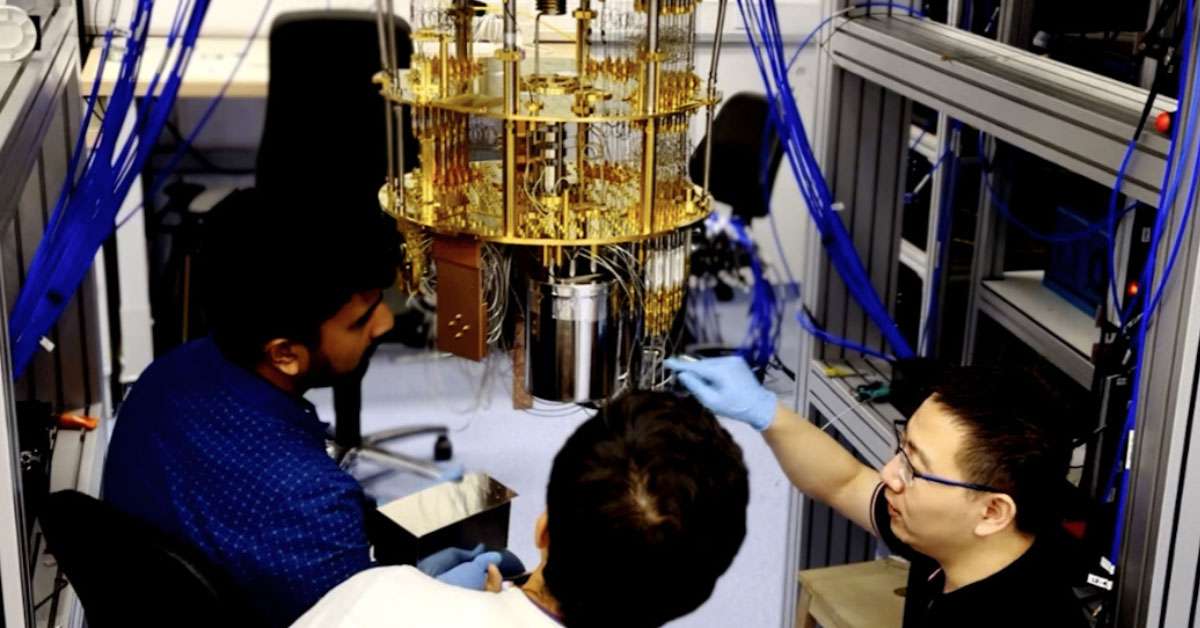
Effective calibration for superconducting quantum computers begins with the classical side: the control and measurement chain. Before attempting to tune qubits, teams should confirm that output channels generate the expected waveforms, input chains provide sufficient gain, and timing relationships between channels are well understood.
This step removes hidden unknowns from the calibration process and ensures that subsequent quantum measurements reflect actual device behavior, not artifacts of the classical electronics. SpinQ’s QCM System for quantum control and measurement is designed specifically to provide stable, low‑noise, and tightly synchronized control for this purpose, forming a robust foundation for downstream quantum calibration.
Step 2: Qubit Discovery and Frequency Calibration
Once the control stack is validated, the next task is to locate and characterize the qubits on the superconducting chip. Typical procedures involve:
-
Spectroscopy sweeps – Scanning drive frequency while monitoring response to identify qubit transition frequencies and resonator modes.
-
Fine‑tuning operating points – Adjusting bias conditions (for tunable qubits) to optimize frequency placement, avoid collisions, and align with coupling network design.
-
Initial coherence measurements – Performing T₁ and Ramsey‑type experiments to estimate relaxation and dephasing times, establishing a baseline for gate design.
SpinQ’s QPU C Series chips ship with factory‑measured frequency maps and key parameters, so users start calibration with detailed prior knowledge rather than a blank slate. This significantly shortens bring‑up time and makes it easier to focus on higher‑level optimization.
Step 3: Single‑Qubit Gate Calibration
With qubit frequencies identified, attention shifts to single‑qubit gate calibration. The goal is to define pulse shapes that implement accurate rotations around desired axes with minimal leakage to non‑computational levels. Practical steps include:
-
Amplitude and duration scans – Varying pulse parameters to find π and π/2 rotation points, often using Rabi oscillation experiments.
-
Phase calibration – Ensuring that nominal X, Y, and composite rotations align with expected Bloch‑sphere axes through Ramsey‑style experiments.
-
Leakage mitigation – Applying shaped pulses (such as DRAG) or numerically optimized waveforms to reduce population in higher energy levels.
The SPINQ SQC series leverages a stable control stack and high‑coherence QPU C Series qubits to support robust single‑qubit gate calibration across all qubits in the device. This creates a uniform baseline on which more complex two‑qubit and multi‑qubit operations can be built.
Step 4: Two‑Qubit Gate and Coupler Calibration
Two‑qubit gates are typically more sensitive to noise and parameter drift than single‑qubit operations, making their calibration a critical step. Common approaches include:
-
Tuning interaction strength – Adjusting coupler parameters or drive conditions to achieve the desired entangling interaction while limiting residual coupling.
-
Phase and echo sequences – Embedding two‑qubit gates in echo‑style sequences to cancel slow noise components and extract clean gate parameters.
-
Gate‑set benchmarking – Using techniques like randomized benchmarking to estimate average error rates for two‑qubit operations.
SpinQ’s superconducting quantum computers offer tunable couplers and 2D lattice layouts that are explicitly designed to support high‑fidelity, calibratable two‑qubit gates and to enable quantum error correction research. By combining hardware features with calibration workflows, users can systematically approach target performance levels required for deeper quantum circuits.
Step 5: Readout Calibration and Discrimination
Accurate measurement is just as important as precise control. In superconducting systems, readout calibration involves:
-
Resonator characterization – Identifying resonator frequencies and optimizing drive power and integration time.
-
State mapping – Measuring response distributions for known |0⟩ and |1⟩ states and choosing discrimination thresholds that balance fidelity and robustness.
-
Multi‑qubit readout optimization – Managing crosstalk and frequency crowding when reading multiple qubits simultaneously.
The SpinQ QCM System is built to support high‑fidelity readout with low‑noise amplification and flexible signal processing, making it easier for users to achieve consistent measurement performance across large qubit arrays. In spin‑based and NMR platforms, we apply similar principles, adapted to their specific signal characteristics, to provide a coherent calibration philosophy across our product lines.
Step 6: Building Automated and Repeatable Calibration Workflows
Given the number of parameters involved, manual calibration does not scale. Modern superconducting quantum computer calibration relies on automation and structured state‑machine management:
-
Automated routines – Software that sequences spectroscopy, Rabi, Ramsey, and more advanced experiments, analyzes results, and updates control parameters.
-
Device‑aware data models – Organizing calibration parameters according to qubit roles (data vs ancilla), couplers, and shared resources to avoid conflicts and maintain consistency.
-
Scheduled recalibration – Running targeted routines at regular intervals to compensate for drift without fully interrupting user workloads.
SpinQ’s superconducting quantum computers are designed to integrate these concepts into their software stack, allowing labs to manage calibration at scale while focusing on their scientific and industrial objectives. This is particularly important as systems grow in qubit count and users explore error‑corrected regimes.
.jpg)
Calibration for Quantum Error Correction and Large‑Scale Systems
As qubit counts rise and quantum error correction becomes feasible, calibration requirements become even more stringent. Beyond per‑qubit performance, teams must ensure:
-
Uniform gate quality across data and ancilla qubits.
-
Stable calibration for repeated syndrome extraction cycles.
-
Low and well‑characterized crosstalk to prevent correlated errors.
SpinQ’s QPU C Series chips are engineered with surface‑code‑compatible 2D lattice topologies, and the SQC series systems are built to support the calibration depth required for such experiments. This makes them suitable platforms for exploring the transition from noisy intermediate‑scale quantum computing to fault‑tolerant architectures.
To complement these efforts, SpinQ also offers NMR quantum platforms that are ideal for teaching and prototyping quantum error‑correction concepts at room temperature before porting them to superconducting hardware.
How SpinQ Simplifies Calibration for Superconducting Quantum Computers
Calibration for superconducting quantum computers is challenging, but it does not have to be a barrier to entry. By combining hardware, control electronics, and software in an integrated stack, SpinQ helps users accelerate from installation to meaningful quantum experiments.
With SpinQ, you gain:
-
QPU C Series superconducting quantum chips with standardized, documented performance metrics.
-
SQC superconducting quantum computers that integrate cryogenics, control, and software for turnkey deployment.
-
The QCM System for stable, low‑noise quantum control and measurement.
-
NMR‑based quantum education platforms that make it easier to train teams on calibration and noise management concepts.
If you are planning a new superconducting quantum computer deployment or looking to improve calibration workflows on existing hardware, you can explore SpinQ’s superconducting quantum computer and quantum chip product pages and reach out to our technical team for a tailored consultation on your calibration roadmap.
Featured Content