
What Is Quantum Computing? A Beginner‑Friendly Guide
2026.04.10 · Blog What Is Quantum Computing? A Beginner‑Friendly Guide
Quantum computing is a new way of processing information that uses the laws of quantum mechanics to solve certain problems much more efficiently than classical computers. Instead of relying only on bits that are either 0 or 1, quantum computers use qubits that can be 0, 1, or a combination of both at the same time.
From Classical Bits to Quantum Qubits
Every classical device you use today—from smartphones to servers—works with bits that represent information as 0 or 1. Those bits are stored and processed using transistors and logic gates that follow deterministic, binary rules. In quantum computing, the basic unit is the qubit, a quantum system whose state can be a superposition of 0 and 1, opening up a much richer space of possible configurations.
Key Quantum Concepts: Superposition, Entanglement, Interference

Superposition allows a qubit to be in a blend of ∣0⟩∣0⟩ and ∣1⟩∣1⟩ until it is measured, enabling a quantum computer to explore many computational paths in parallel. Entanglement links qubits so that the state of one depends on the state of another, even when they are physically separated, creating powerful correlations for computation. Quantum interference then lets useful probability amplitudes reinforce each other while unwanted ones cancel out, which is how quantum algorithms amplify correct answers over incorrect ones.
How a Quantum Computer Works at a High Level
A typical quantum program begins by initializing qubits in a well‑defined state, often ∣0⟩∣0⟩ for all qubits. Quantum gates—implemented as precise physical operations—then manipulate these qubits to create superposition, entanglement, and interference that encode a solution. Finally, a measurement step converts the quantum state back into classical bits that you can interpret as the result of the computation.
Different Types of Quantum Hardware
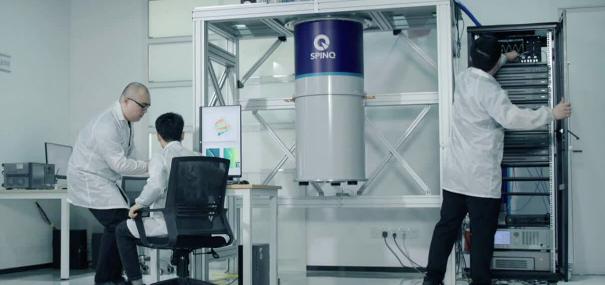
There is no single way to build a quantum computer, and several hardware platforms are currently under active development. Leading approaches include superconducting qubits, trapped ions, photonic qubits, neutral atoms, and semiconductor quantum dots, each with unique strengths and trade‑offs. Superconducting systems—like SpinQ’s SQC series—offer fast gate times and strong compatibility with existing chip‑fabrication technologies, while NMR‑based devices from SpinQ provide highly stable qubits for education and early experimentation.
What Can Quantum Computers Do Better?
Quantum computers are not universally faster than classical machines, but they can dramatically speed up specific tasks. Well‑known examples include factoring large numbers, searching unsorted databases, simulating quantum systems such as molecules and materials, and optimizing complex systems with many interacting variables. These capabilities have potential impact across industries ranging from drug discovery and chemistry to logistics, finance, cybersecurity, and advanced AI workflows.
Current Limitations: Noise, Decoherence, and Error Correction
Today’s quantum computers are still in the noisy intermediate‑scale quantum (NISQ) era, where qubits are limited in number and prone to errors. Decoherence, imperfect control, and environmental noise quickly degrade quantum information, limiting circuit depth and algorithm complexity. Quantum error correction promises a path to fault‑tolerant quantum computing, but it requires many physical qubits to encode one logical qubit, driving a strong need for scalable, high‑fidelity hardware such as SpinQ’s superconducting platforms.
How SpinQ Is Bringing Quantum Computing to Life
SpinQ focuses on making quantum computing practical and accessible by delivering full‑stack systems that cover chips, cryogenics, control electronics, and software. Its superconducting SQC series scales to over 100 qubits with long coherence times and high gate fidelities, supporting advanced research and industry pilots. At the same time, SpinQ’s desktop and educational quantum devices, along with beginner‑friendly learning content, provide an on‑ramp for students, developers, and enterprises to start building quantum skills today.
Featured Content