
What a Superconducting Quantum Computer Really Looks Like: From Chip to Cryostat
2026.08.10 · Blog what does a quantum computer look like
When people hear “quantum computer,” they often picture a sleek black box or a futuristic version of a laptop. In reality, a superconducting quantum computer looks nothing like a traditional PC or even a rack of servers. It is a large, layered scientific instrument that combines a fingernail‑sized chip at the center with a massive cryogenic tower, dense wiring, and rows of control electronics.
In this article, we walk through what a superconducting quantum computer really looks like—from the quantum chip where computation happens, down through the golden “chandelier” and cryostat, all the way out to the racks of electronics and integrated full‑stack systems that companies like SpinQ deliver to industry.
The Heart of the System – Superconducting Quantum Chip
At the core of every superconducting quantum computer is a small, flat chip fabricated on a solid substrate such as silicon or sapphire. Physically, it looks similar to a high‑end microwave or RF device rather than a consumer CPU. The surface of the chip is patterned with thin metallic structures—typically aluminum or niobium—that form the superconducting circuits.
If you look closely, you do not see “tiny transistors” in the usual CMOS sense. Instead, you see geometric metal islands, loops, and junctions. Many modern superconducting qubits use architectures such as the transmon qubit, where two larger metal “pads” are connected by a Josephson junction. This arrangement behaves as a non‑linear LC oscillator when cooled to superconducting temperatures, and it is this circuit that hosts the quantum states. On a multi‑qubit chip, these motifs repeat in an organized layout: arrays of qubit structures, coupling resonators, and readout circuits, all etched and deposited to form a compact planar device.
From above, the chip might be a few centimeters on a side, mounted on a carrier or inside a small metal module. It looks delicate but unremarkable—more like a specialized RF circuit than a sci‑fi “quantum brain.” Yet all the quantum logic, entanglement, and interference happen in this tiny piece of hardware.
.jpg)
From Chip to Cryostat –Why It Looks Like a Golden Chandelier
Why Superconducting Quantum Computers Need a Cryostat
Superconducting qubits only behave as intended when their circuits are in the superconducting state and environmental noise is suppressed. That requires temperatures close to absolute zero—typically in the range of tens of millikelvin. To reach and maintain those conditions, superconducting quantum computers are housed inside dilution refrigerators, also known as cryostats.
These cryostats are multi‑stage cooling systems. Heat is removed step by step as you go down through temperature “plates”: from room temperature to 4 K (liquid helium range), then to 1 K, then to around 100 mK, and finally to the base temperature of around 10–20 mK. Each stage hosts specific components that can tolerate that temperature and contribute to filtering, shielding, or control. This layered thermal architecture is a big reason why the machine looks so tall and complex.
What the Cryostat Looks Like From the Outside
From the outside, a cryostat for a superconducting quantum computer appears as a tall cylindrical metal enclosure or a cabinet that integrates the refrigerator and mechanical support. It can be roughly person‑height or taller, with heavy metal surfaces, vacuum ports, and service interfaces. To someone unfamiliar with cryogenic systems, it looks more like a large industrial chiller or physics apparatus than anything related to computing.
The outer shell is usually built from stainless steel or similarly robust materials. Within this shell, there are nested vacuum chambers and radiation shields. Even though the exterior may look plain—brushed metal walls, flanges, and support frames—the interior is highly engineered, with concentric layers that cut off heat flow and stray radiation from the environment.
The Iconic Golden “Chandelier” Inside
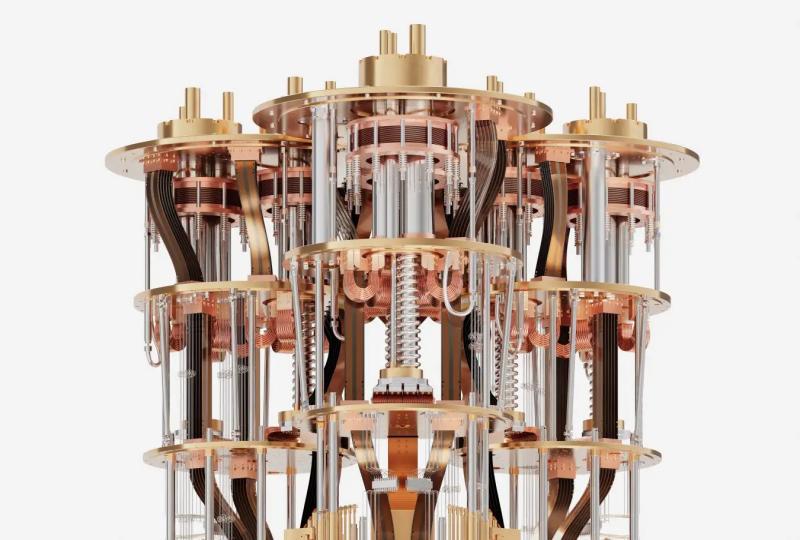
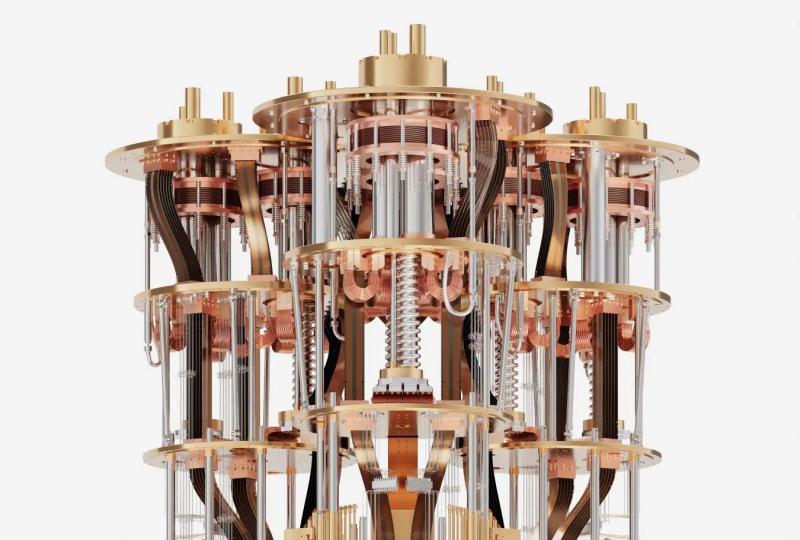
When media outlets show visuals of a superconducting quantum computer, they usually focus on what hangs inside the cryostat: a vertical stack of golden plates and dense wiring often described as a “chandelier.” This chandelier is not decorative; it is the cryogenic structure that connects the different temperature stages, houses filters and amplifiers, and carries hundreds of coaxial cables down toward the chip.
Each plate in this structure sits at a specific temperature and is made from high‑conductivity metals such as copper, often gold‑plated to improve surface properties and reduce oxidation. Devices like attenuators, filters, and amplifiers are bolted onto specific levels. Coaxial cables are routed from the top (room‑temperature electronics) down through these plates, with thermal anchoring and shielding at each step. The result is a visually striking, layered object: shiny golden disks, braided or bundled cables, and mechanical supports forming a vertical, tree‑like assembly.
Near the very bottom of the chandelier—at the coldest stage—the superconducting quantum chip is mounted inside a small enclosure or on a sample holder. Many photos do not show the chip directly; they show the structure that holds and cools it. So when you see the famous chandelier images, you are mainly looking at the cooling and wiring infrastructure that makes the chip usable, rather than the chip itself.
The Invisible Web – Control Electronics, Wiring, and Shielding
What You See Around the Cryostat: Racks and Electronics
A superconducting quantum computer is not just the cryostat. Around it, you will find racks of electronic instruments that generate and capture the signals needed to control and read out the qubits. These racks look like those in an RF lab or advanced test facility: stacked devices with screens, knobs, cables, and status LEDs.
Typical equipment includes microwave signal generators, arbitrary waveform generators, frequency synthesizers, low‑noise amplifiers, and digitizers. Classical control hardware produces precisely shaped microwave and flux pulses that implement quantum gates and measurements on the chip, and it digitizes the reflected or transmitted signals to infer qubit states. Visually, this part of the system resembles a high‑end instrumentation setup more than a traditional server farm.
Dense Wiring and Why Each Qubit Needs So Many Lines
One reason superconducting quantum computers look so busy is the sheer number of cables. Each qubit can require multiple dedicated lines: drive lines that deliver gate pulses, flux lines that tune qubit frequencies or couplers, and readout lines connected to resonators that sense the qubit state. When you scale to dozens or hundreds of qubits, the number of coaxial cables grows quickly.
From the room‑temperature racks, bundles of coaxial cables enter the top of the cryostat. As they run downward through the chandelier, they are thermally anchored and filtered at each temperature plate. Visually, this produces dense arrays of cables that curve and loop from plate to plate, forming the iconic “golden vines” around the chandelier structure. Many cables use copper or gold‑plated conductors and carefully chosen dielectrics to maintain signal integrity from room temperature down to millikelvin.
Shielding, Vibration Isolation, and Vacuum Chambers
Beyond the obvious metal and cables, several “invisible” design elements shape how the system looks:
-
Nested vacuum chambers and radiation shields build concentric metallic shells around the core. These shells look like stacked cans or cylinders when opened, and they are essential for blocking thermal radiation and ambient electromagnetic noise.
-
Vibration isolation influences the support structure. The chandelier may be suspended from a rigid frame designed to minimize mechanical noise coupling into the chip. This is why the assembly often appears “hung” from the top rather than simply sitting on a flat base.
-
Magnetic shielding can add further layers or special materials around the cold stages, shaping the interior layout and contributing to the machine’s industrial, experimental aesthetic.
Altogether, these elements mean that a superconducting quantum computer looks like a carefully engineered nest of metal, cables, and instruments whose primary job is to protect and drive a small chip at the bottom.
.jpg)
From Lab Apparatus to Integrated Systems – How It Looks as a Product
Superconducting Quantum Computers as Full-Stack Systems
If you step back from the cryostat and electronics, what you see is not just a single machine, but a full‑stack quantum computing system. It includes the quantum chip, cryogenic hardware, control electronics, classical computing and networking, and the software stack that orchestrates workloads.
In a lab or data center, the “visual footprint” of a superconducting quantum computer typically spans a cluster of equipment: the central cryostat tower, adjacent instrument racks, cabling routes, control workstations, and networking links. Engineers interact with the system via screens and software tools, not directly via the chandelier. From the user’s perspective, it looks like a combination of specialized physics equipment and professional IT infrastructure.
How SpinQ Packages Superconducting Technology for Industry
SpinQ focuses on turning this complex apparatus into industrial‑grade solutions. Rather than leaving the system as a one‑off lab experiment, SpinQ builds superconducting quantum computers and associated hardware and software into coherent products that can be deployed and operated by organizations.
That full‑stack approach brings together superconducting quantum chips, cryogenic platforms, quantum control systems, and algorithm software. In practice, SpinQ’s industrial superconducting quantum systems are delivered as integrated configurations that combine the core cryostat hardware with tailored control racks and software interfaces, making the overall setup look and behave more like a robust, engineered solution than a fragile research prototype. This packaging helps enterprises in fields such as finance, chemistry, and AI move from “seeing a golden chandelier in a lab” to actually running quantum workloads on scalable systems.
By designing superconducting quantum chips alongside measurement and control infrastructure, SpinQ ensures that the physical appearance of the system reflects its industrial role: modular cabinets, structured cabling, and clearly defined interfaces between quantum and classical components. Visually, it is still a sophisticated scientific instrument—but one that fits into an engineered ecosystem and can be integrated into real‑world environments.

Featured Content