
Understanding Quantum Bits and Why They Matter
2025.12.04 · Blog quantum bits
Quantum bits—commonly called qubits—are the fundamental units of quantum information. Their importance comes from their ability to represent and process data in ways that far exceed the capabilities of classical computing. While a classical bit can only exist as 0 or 1, a qubit can occupy a rich continuum of states due to the phenomenon of superposition. This property allows quantum computers to explore huge solution spaces simultaneously, opening new pathways for computation, simulation, and optimization.
How Qubits Differ from Classical Bits

The defining characteristic of a qubit is its ability to encode both 0 and 1 at the same time, described mathematically as a linear combination of basis states. This multidimensional flexibility gives qubits a powerful advantage: multiple possible outcomes can be processed in parallel. In contrast, classical bits evaluate each possibility sequentially.
Another major difference lies in entanglement—the deep, non-classical correlation between qubits. When qubits are entangled, the state of one immediately influences the state of another, even if they are spatially separated. This relationship is essential for quantum algorithms such as Grover’s search and Shor’s factorization. As algorithms grow in complexity, the need for highly stable and controllable qubits becomes even more important, particularly as industries move from theoretical concepts to practical, real-world quantum applications.
Superposition, Entanglement, and Quantum State Control
Managing the state of a qubit requires delicate control. Superposition allows qubits to explore many computational paths, but it must be maintained long enough for calculations to occur. Entanglement makes multi-qubit operations exponentially more powerful, but also exponentially more vulnerable to noise. Achieving stability, long coherence times, and high-fidelity operations requires sophisticated engineering, from cryogenic environments to advanced measurement and control systems. These characteristics define the practical utility of qubits in research, education, and commercial environments.
The Physical Realizations of Quantum Bits
Qubits are not abstract concepts—they must be built from physical systems that exhibit quantum mechanical behavior. Over the past decade, several platforms have emerged as leading candidates for scalable quantum computing. Each implementation has unique strengths and engineering challenges.
Superconducting Qubits
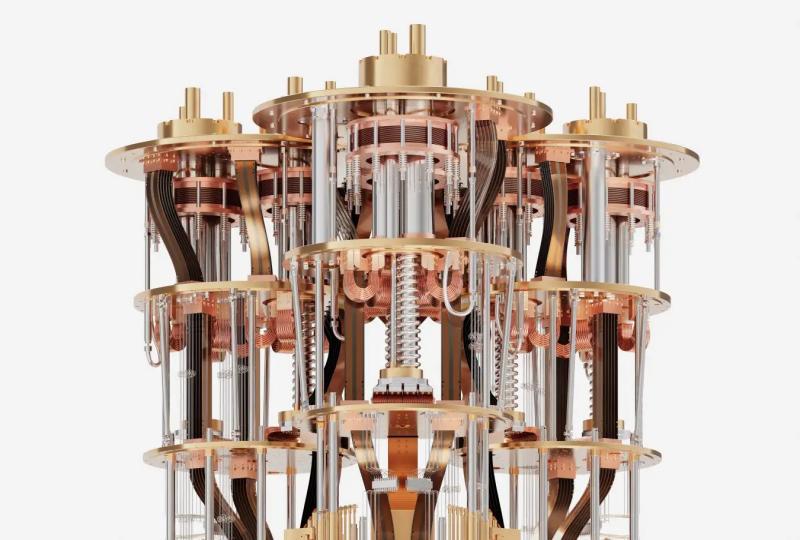
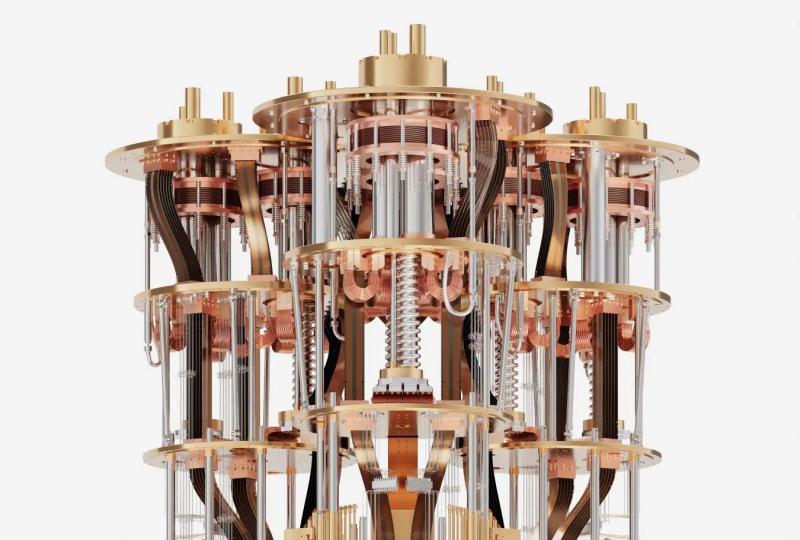
Superconducting qubits are currently among the most advanced and commercially prominent architectures. Constructed using superconducting circuits that incorporate Josephson junctions, these qubits operate at extremely low temperatures, often within 20 millikelvin environments. They are known for their scalability, precise gate control, and compatibility with existing semiconductor fabrication techniques.
Modern superconducting systems are paired with specialized quantum measurement and control platforms. Such systems use high-precision RF signal arrays, advanced synchronization electronics, and FPGA-accelerated processing to ensure fast, accurate qubit operations. When implemented properly, they can support hundreds of qubits and achieve high-fidelity gate operations necessary for complex quantum algorithms.
Nuclear Magnetic Resonance (NMR) Qubits
NMR-based qubits represent another important category, particularly in education and research environments. They rely on the spin states of atomic nuclei within a controlled magnetic field. NMR technology has the advantage of stability, room-temperature operation in certain configurations, and the ability to demonstrate core quantum computing principles in a highly accessible way.
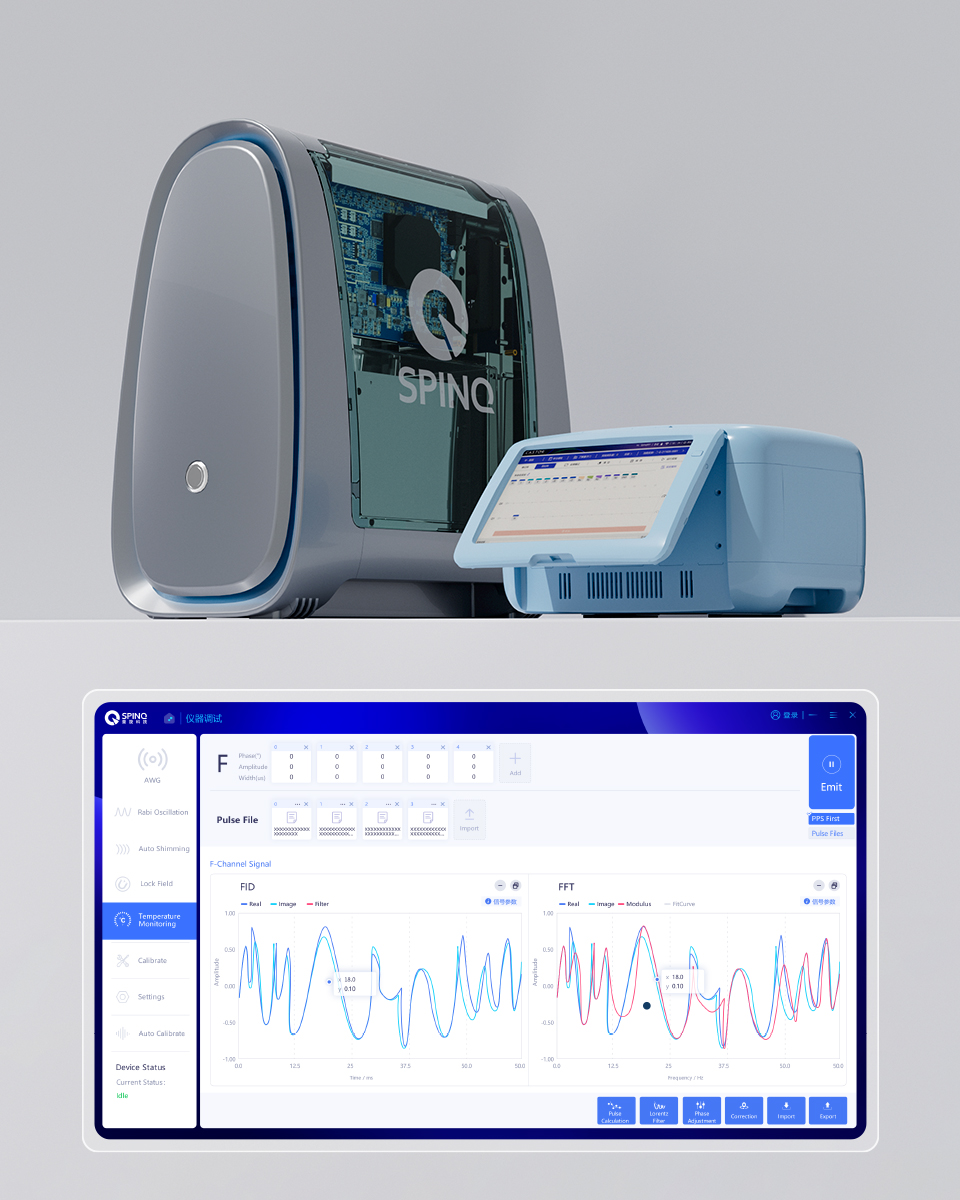
Small-scale NMR quantum systems offer real, physical qubits that can operate inside classrooms and labs without the need for cryogenic infrastructure. These systems often include integrated RF controls, touchscreen interfaces, and built-in training modules, providing a complete entry-level quantum learning platform.
Emerging Qubit Platforms
Beyond superconducting and NMR qubits, additional platforms continue to push the field forward. Photonic qubits leverage single photons for quantum information; trapped ion qubits use charged atomic particles; and neutral atom systems create highly scalable qubit arrays. Although each platform faces unique challenges—such as control complexity or integration scalability—they contribute valuable progress to the global effort toward practical quantum computing.
How Quantum Bits Enable Real Computational Advantage
The potential of qubits lies in their ability to perform operations that classical hardware cannot efficiently replicate. The more stable and controllable a qubit is, the more meaningful the computational advantage becomes.
Quantum Gate Operations and Coherence
Quantum gates manipulate the probability amplitudes of a qubit. For practical computation, these gates must operate with extremely high precision, often exceeding 99% fidelity. Achieving this level of performance requires engineering excellence in both hardware and measurement systems.
Coherence time—the duration a qubit remains in a usable quantum state—is equally critical. Longer coherence allows more complex algorithms to run without errors. Modern systems achieve longer lifetimes through optimized chip design, low-noise cryogenic hardware, and advanced calibration techniques.
Scaling Qubits for Large-Scale Quantum Systems
Scaling from a handful of qubits to hundreds or thousands is one of the defining challenges of the industry. Superconducting platforms have made significant strides here due to their compatibility with microfabrication and modular control systems. Meanwhile, NMR systems offer smaller but highly stable qubits ideal for demonstration and foundational research. Combining scalable architectures with robust qubit control will determine which technologies ultimately lead toward large-scale quantum advantage.
Real-World Application Scenarios
Different industries are already exploring how qubits can accelerate computing tasks:
-
Scientific Research: Qubits enable simulation of molecular structures and quantum phenomena that exceed classical limits.
-
Drug Discovery: Quantum models can optimize molecular interactions and improve discovery pipelines.
-
Financial Technology: Qubits improve risk modeling and portfolio optimization by exploring multidimensional solution spaces.
-
Artificial Intelligence: Quantum-enhanced algorithms can analyze large datasets more efficiently, boosting AI model performance.
As more organizations adopt quantum hardware and cloud-based platforms, practical applications will advance rapidly.
Education-Driven Qubit Accessibility

Qubit education is vital for building the next generation of quantum engineers and scientists. Recently, compact and user-friendly systems have made hands-on learning far more accessible.
Classroom-Ready Quantum Systems
Modern quantum education platforms offer real, operational qubits in university environments. These systems use NMR-based architectures to deliver stable qubit performance without the need for cryogenic cooling. Students can run real quantum algorithms, experiment with quantum states, and visualize entanglement in a hands-on manner that was once impossible.
Such platforms often include integrated teaching modules, algorithm libraries, and intuitive interfaces designed specifically for undergraduates and graduate-level learners. They bridge the gap between theory and real quantum experimentation.
Portable Qubit Devices for Beginners
Portable 2-qubit devices have emerged as powerful tools for learning and demonstrations. They pack a real quantum system, touchscreen controls, and pre-installed learning courses into a compact form factor. These portable systems are designed to accommodate varying learning backgrounds—making them ideal for workshops, seminars, and self-guided exploration. Their simplicity helps new learners grasp algorithmic concepts and the behavior of qubits in a controlled environment.
Cloud-Connected Qubits and Software Ecosystems
The rise of quantum cloud platforms has further expanded global access to qubits.
Remote Access to Real Quantum Hardware
Quantum cloud services allow users to run quantum circuits on real systems containing 8-qubit, 5-qubit, 3-qubit, and 2-qubit machines, along with high-performance CPU/GPU-based simulators reaching up to 24 qubits. This model removes the barrier of physical hardware ownership, enabling researchers and hobbyists to experiment with advanced quantum systems from anywhere.
These platforms also prioritize security, offering enterprise-level private deployments for institutions that need isolated, dedicated quantum computing environments.
Quantum Programming Frameworks for Developers
Modern quantum frameworks let developers write quantum algorithms using familiar languages such as Python. They provide quantum circuit libraries, algorithm modules, simulator connections, and interfaces that link directly to physical quantum hardware. Such frameworks empower developers to prototype ideas, run hybrid classical-quantum tasks, and explore practical quantum software development without requiring hardware expertise.
Challenges and the Road Toward Reliable Qubit Technology
Qubit technology is advancing quickly, but several obstacles remain before universal quantum computing becomes mainstream.
Noise, Error Mitigation, and Stability Issues
Qubits are extremely sensitive to environmental disturbances, including temperature variations, electromagnetic noise, and even minute vibrations. These factors lead to decoherence and operational errors. Improving performance requires innovations in chip design, noise-resistant control systems, and advanced error mitigation techniques.
Engineering Progress and Future Directions
Despite challenges, progress continues at an impressive pace. Hardware teams are refining superconducting chip quality with higher stability and longer lifetimes. Control systems are becoming more modular, precise, and scalable. Meanwhile, education-oriented systems and cloud platforms are expanding access to real, hands-on quantum environments.
The combination of powerful hardware, stable qubit platforms, and accessible learning tools ensures that quantum computing will continue evolving from specialized research laboratories into practical technology applied across industries worldwide.
Featured Content