
Superconducting QPU Technology: Design, Fabrication, and Performance Metrics
2026.09.02 · Blog Superconducting Quantum Computing System technology
A superconducting quantum processing unit, or QPU, is the chip that performs the core quantum operations inside a superconducting quantum computer. It creates and controls quantum states, enables qubits to interact, and produces the measurement data used to run quantum experiments. For a research team, a university laboratory, or an enterprise R&D group, the practical question is not only how many qubits a processor contains. It is whether the chip can deliver stable, repeatable performance within a complete quantum computing environment.
SPINQ develops quantum computing hardware solutions for organizations that need to move from quantum concepts to real hardware research. From superconducting QPUs and chip development to control electronics, cryogenic deployment, software, and integration support, the focus is on helping teams build a coordinated platform for device testing, algorithm validation, and long-term quantum capability.
This guide explains what determines superconducting QPU performance, how design and fabrication decisions affect usable results, and which metrics matter when evaluating a processor or a quantum hardware partner.
What Is a Superconducting QPU?
A superconducting QPU is an integrated quantum chip that contains superconducting qubits and the circuits needed to control, couple, and measure them. It operates at ultra-low temperatures, commonly in the millikelvin range, where superconducting circuits can retain quantum behavior long enough to execute quantum operations.
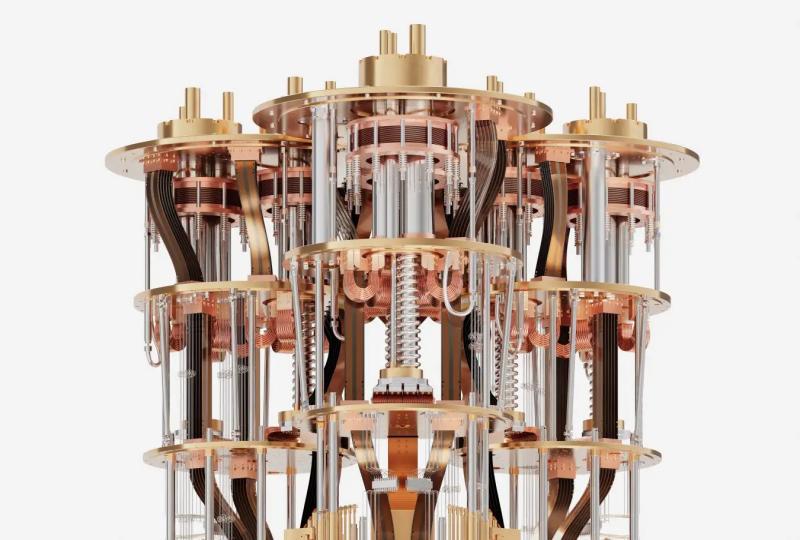
A QPU is not a standalone computer. It must operate with a dilution refrigerator, microwave control and readout electronics, cryogenic RF components, calibration tools, and quantum software. The QPU performs the quantum operations, while the surrounding system provides the low-noise conditions, control pulses, measurement signals, and classical feedback required to run experiments reliably.
In practice, a superconducting quantum computing platform combines the QPU, a control and measurement system, a cryogenic environment, pulse-level software, programming interfaces, and technical support for installation and operation. Evaluating these layers together gives a more realistic picture of what the hardware can achieve in a laboratory or R&D setting.
The Building Blocks of a Superconducting Quantum Chip
Superconducting Qubits
Qubits are the basic units of quantum information. In a superconducting QPU, they are electrical circuits designed to behave as quantum systems at extremely low temperatures. Many processors use transmon-style qubits because they offer a practical balance between controllability and reduced sensitivity to electrical charge noise.
A qubit must preserve its state long enough to be prepared, manipulated, coupled with other qubits, and measured. This is why qubit geometry, material selection, circuit frequency, and electromagnetic design all have a direct influence on QPU performance.
Josephson Junctions
A Josephson junction is a small insulating barrier between two superconducting materials. It creates the nonlinearity that enables a superconducting circuit to act as a controllable qubit rather than an ordinary resonator.
Its fabrication quality affects qubit frequency, parameter consistency, stability, and usable device yield. Small variations in junction properties can create frequency collisions across a chip or make a multi-qubit processor harder to calibrate after cooldown.
Readout Resonators, Control Lines, and Couplers
Each qubit needs a way to receive control signals and return measurement information. Microwave control lines deliver pulses that prepare quantum states and execute quantum gates. Readout resonators enable the system to infer the final state of each qubit from measured microwave responses.
Couplers enable controlled interactions between qubits. These interactions make entangling gates possible, which are required for multi-qubit algorithms and quantum error-correction research. The design challenge is to control each qubit precisely while reducing noise, unwanted coupling, and interference with neighboring devices.
Qubit Design Choices That Influence Performance
Fixed-Frequency and Tunable Qubits
Fixed-frequency qubits operate at frequencies defined during chip design. They can reduce some sources of flux-related noise, but they require careful frequency allocation so that neighboring qubits do not interfere with one another.
Tunable qubits allow frequencies to be adjusted through external control. This can provide additional flexibility for calibration and gate operations, but it also increases control complexity and may introduce sensitivity to flux noise. The appropriate design depends on the target architecture, gate scheme, system scale, and intended research tasks.
Frequency Planning and Anharmonicity
Superconducting QPUs use microwave frequencies to address qubits and perform quantum operations. Frequency planning helps each qubit remain individually controllable while reducing frequency collisions and unwanted interactions.
Anharmonicity helps separate a qubit's computational states from higher unwanted energy states. If this separation is insufficient, a control pulse can cause leakage, meaning that a qubit leaves the intended computational space during a gate operation. Effective QPU design balances addressability, compatible gate frequencies, resistance to manufacturing variation, and low leakage.
Topology, Connectivity, and Crosstalk
The physical arrangement of qubits determines which qubits can interact directly. Local connectivity can simplify hardware design and help manage unwanted interactions, but limited connectivity may require extra routing operations when compiling an algorithm. Those additional operations increase circuit depth and create more opportunities for error.
Crosstalk occurs when a control or measurement signal intended for one qubit affects another. It can result from microwave leakage, frequency overlap, parasitic coupling, shared signal paths, or packaging limitations. A strong processor design considers layout, coupling, frequency allocation, filtering, shielding, and control architecture together to reduce these effects.
Superconducting QPU Fabrication: From Design to Device
Fabrication is a major part of QPU performance. A well-designed circuit cannot compensate for uncontrolled materials, inconsistent Josephson junctions, surface loss, poor packaging, or process variation. High-performance quantum chips require coordination between circuit design, micro-nano fabrication, packaging, and cryogenic characterization.
Materials and Surface Quality
Superconducting quantum circuits are sensitive to losses at material interfaces. The substrate, superconducting film, dielectric layers, surface preparation, and cleanliness of fabrication processes can all affect how long a qubit maintains a useful quantum state.
Microscopic defects, contamination, interface loss, and unintended resonances can reduce coherence. For this reason, a QPU manufacturing process should be assessed by its ability to deliver repeatable device performance, not solely by whether a chip can be fabricated.
Core Manufacturing Stages
A superconducting QPU fabrication workflow commonly begins with circuit layout and electromagnetic simulation. It then moves through substrate preparation, thin-film deposition, lithography, pattern definition, etching or lift-off, Josephson junction fabrication, dicing, packaging, and interconnect assembly.
Before a QPU is used for quantum operations, it typically undergoes room-temperature screening followed by cryogenic testing. These steps help identify whether qubits, resonators, couplers, and signal paths behave as expected under operating conditions.
Uniformity and Manufacturing Yield
Building a repeatable QPU platform requires more than producing one successful prototype. Research teams need consistent qubit frequencies, predictable parameters, usable yield, and reliable performance across multiple devices and fabrication runs.
When evaluating a manufacturing or technology partner, it is useful to ask how parameter variation is controlled, how out-of-specification devices are identified, how yield is measured after cryogenic testing, and whether custom chip architectures can be supported without sacrificing repeatability.
How Superconducting QPUs Are Tested and Calibrated
Testing and calibration turn a fabricated quantum chip into a usable QPU. The processor must be characterized under cryogenic operating conditions, and the control system must be tuned to execute reliable quantum operations.
Device Characterization
Initial characterization commonly measures qubit transition frequencies, resonator frequencies, anharmonicity, coupling strengths, quality factors, control responses, and readout signal separation. These measurements confirm whether the physical device aligns with the intended design and provide the information required for later calibration.
Coherence Measurements
Coherence describes how long a qubit can retain useful quantum information. T1 relaxation time measures how long a qubit retains energy before returning to its lower-energy state. T2* measures how quickly phase coherence is lost under normal operating noise conditions. T2 echo measures coherence after reducing the influence of certain low-frequency noise sources.
Longer coherence can allow more quantum operations before information is degraded. However, coherence metrics should not be evaluated alone. They can vary over time and do not fully describe readout accuracy, crosstalk, gate calibration, or algorithm-level performance.
Gate and Readout Calibration
Calibration determines the pulse shapes, amplitudes, durations, phases, and frequencies needed to perform quantum gates accurately. Single-qubit calibration is essential, but two-qubit calibration is often more demanding because entangling gates are more sensitive to crosstalk, leakage, frequency collisions, and control errors.
Readout calibration is equally important. A correctly prepared quantum state still produces an unreliable result if the measurement system cannot distinguish it accurately. A useful QPU evaluation should therefore consider gate performance and readout performance together.
Performance Metrics That Matter
Qubit Count
Qubit count measures the number of physical qubits integrated into a processor. It is important for scaling, but it is not enough to define practical capability. A larger QPU may be less useful for a particular task if its two-qubit gates have lower fidelity, its connectivity is limited, its calibration is unstable, or crosstalk is high.
The number of usable qubits is often more meaningful than the nominal number of qubits. Usability depends on how many qubits meet target performance levels and can operate reliably as part of a multi-qubit circuit.
Coherence Time
T1, T2*, and T2 echo measurements indicate how long qubits can preserve quantum information. These measurements should be reviewed as distributions across active qubits rather than as a single best-case number.
Useful coherence data includes median values, operating conditions, test temperature, measurement time frame, and stability over repeated measurements. This helps determine whether the QPU can support consistent research activity rather than a one-time benchmark result.
Gate Fidelity and Gate Time
Gate fidelity measures how closely a performed quantum operation matches the intended operation. Both single-qubit and two-qubit gate fidelity matter, but two-qubit gate fidelity is especially important because entanglement is required by most meaningful quantum algorithms and error-correction protocols.
Gate duration matters because quantum operations must finish before coherence is lost. Still, faster gates are not automatically better if they increase leakage, unwanted coupling, or control errors. The goal is a balanced combination of accurate, stable, and efficiently executed operations.
Readout Fidelity, Crosstalk, and Stability
Readout fidelity measures how accurately the system identifies a qubit's final state. It affects experiment results, algorithm verification, error mitigation, and feedback-based control. Multi-qubit experiments also require attention to correlated readout errors, not only individual qubit measurements.
Stability indicates whether a QPU can maintain calibrated performance over time. A processor may show strong results during a short test but require frequent recalibration if operating parameters drift. For continuous research and development, stable and repeatable performance is often as valuable as a high peak result.
Why QPU Metrics Must Be Evaluated Together
Imagine two processors. One has 100 physical qubits but lower two-qubit gate fidelity, high crosstalk, and frequent calibration drift. The other has 30 physical qubits but stronger entangling gates, more reliable readout, lower interference, and better stability. For many near-term experiments, the second processor may deliver more useful results despite having fewer qubits.
This is why QPU selection should assess architecture, fabrication quality, coherence, gate performance, readout, connectivity, crosstalk, yield, and calibration stability as a connected system. A practical review should also include compatibility with the selected control electronics and cryogenic infrastructure.
Scaling Superconducting QPUs
Scaling a superconducting QPU requires more than adding qubits to a chip. Larger processors need more control and readout channels, more cryogenic wiring, more calibration resources, and more robust thermal and signal management. Without careful system engineering, added complexity can increase heat load, signal loss, interference, and maintenance demands.
Packaging and Cryogenic Integration
A superconducting QPU must be properly packaged, thermalized, shielded, and connected to cryogenic RF hardware. Its performance depends on the entire signal path between room-temperature electronics and the ultra-low-temperature chip environment.
SPINQ offers superconducting quantum computing products that support QPU development, quantum control and measurement, chip fabrication and testing, and cryogenic environment deployment. This integrated approach helps organizations connect chip-level work with the infrastructure needed for operating and expanding a real quantum research platform.
Control Systems for Multi-Qubit Operation
As QPU scale increases, control electronics must provide low-noise, high-precision signal generation and acquisition across more channels. The system needs to support pulse-level control, efficient readout, characterization workflows, and calibration routines that can keep pace with a growing processor.
A modular control architecture can help laboratories expand their capability over time while maintaining compatibility with different QPU configurations. Pulse-level access and software interfaces are also important for teams that need to conduct device research, develop custom controls, or validate new quantum algorithms on physical hardware.
Quantum Error-Correction Readiness
Quantum error correction requires many physical qubits to protect logical quantum information. It places demanding requirements on two-qubit gate performance, readout, crosstalk management, connectivity, real-time control, and calibration stability.
Supporting quantum error-correction research, demonstrating a small error-detection experiment, and achieving scalable fault-tolerant quantum computing are different milestones. A clear QPU roadmap should distinguish among these stages and align the processor architecture with realistic research objectives.
How to Evaluate a Superconducting QPU Partner
Choosing a QPU supplier, fabrication partner, or integrated system provider should begin with the intended use case. The right solution for chip research may differ from the right solution for quantum algorithm development, system construction, application validation, or long-term quantum capability building.
Design and Architecture Questions
Ask which qubit design and coupling method are used, whether the processor relies on fixed-frequency or tunable qubits, what topology is available, and how the architecture addresses frequency collisions, leakage, and crosstalk. Teams with specific research needs should also determine whether the QPU architecture can be customized.
Manufacturing and Testing Questions
Ask whether the provider supports chip design, fabrication, packaging, and cryogenic characterization. Request data on coherence, gate fidelity, readout, stability, yield, and parameter uniformity. It is also important to understand how the provider validates a device before delivery and supports iterative chip development.
Integration and Support Questions
Confirm QPU compatibility with the selected control and measurement system, cryogenic environment, software tools, and programming interfaces. Installation, calibration, training, maintenance, and upgrade support should be considered early, especially for organizations that are building new superconducting quantum laboratories.
For institutions and R&D teams that need a coordinated route from quantum hardware selection to operational deployment, industrial-grade quantum computing products and services can help connect QPU technology with the supporting control, software, and infrastructure layers.
Frequently Asked Questions
What is the difference between a QPU and a quantum computer?
A QPU is the quantum chip that contains qubits and quantum circuits. A quantum computer is the full system that includes the QPU, cryogenic environment, control and measurement electronics, software, and supporting infrastructure.
Is a higher qubit count always better?
No. Qubit count is important, but gate fidelity, readout fidelity, coherence, connectivity, crosstalk, calibration stability, and usable yield also determine whether a QPU can run meaningful quantum circuits.
Why is two-qubit gate fidelity important?
Two-qubit gates create entanglement, which is required for most quantum algorithms and quantum error-correction protocols. Their errors can accumulate rapidly in multi-qubit circuits, making two-qubit gate fidelity a critical performance metric.
Build for Reliable Quantum Research
Superconducting QPU technology brings together quantum physics, microwave engineering, micro-nano fabrication, cryogenic infrastructure, and software control. A useful processor is not defined by qubit count alone. It is defined by how well its qubits are designed, fabricated, characterized, controlled, and integrated into a stable operating environment.
By evaluating the full pathway from qubit architecture and chip manufacturing to control, testing, and deployment, research institutions and enterprise R&D teams can build a stronger foundation for practical quantum development.
Featured Content