
Superconducting Quantum Chip Noise Reduction Explained
2026.06.11 · Blog superconducting quantum chip noise reduction
Superconducting Quantum Chip Noise Reduction: From Lab Challenge to Scalable Solution
Noise is the central obstacle between today’s superconducting quantum chips and tomorrow’s large‑scale, fault‑tolerant quantum computers. Every fluctuation in the environment can disturb fragile qubit states, introduce errors into quantum gates, and limit the depth of algorithms that can run reliably. For researchers and industry users, mastering superconducting quantum chip noise reduction is no longer optional; it is the foundation of meaningful quantum advantage.
SpinQ focuses on delivering superconducting quantum processors that integrate noise‑reduction techniques from the chip layout all the way to the cryogenic and control stack. By combining robust engineering with turnkey systems, we help universities, research labs, and enterprises move beyond proof‑of‑concept experiments to repeatable, high‑fidelity quantum computing.
Where Does Noise Come From in Superconducting Quantum Chips?
Superconducting qubits behave like artificial atoms whose quantum states are defined by microwave‑frequency currents and voltages in Josephson‑junction circuits. Because these energy levels are closely spaced and highly sensitive, even subtle disturbances can cause decoherence or gate errors. The most important noise sources include several well‑studied mechanisms.
-
Materials and interface defects: Imperfections at metal–dielectric interfaces and substrate surfaces can absorb energy and reduce qubit lifetimes.
-
Charge and flux noise: Fluctuations in local charge or magnetic fields shift qubit frequencies and dephase superposition states.
-
Crosstalk and control errors: Imperfect isolation between qubits or control lines can cause unintended rotations and correlated errors.
-
Thermal photons and electromagnetic interference: Residual thermal energy or external RF signals can randomly excite or dephase qubits.
Noise reduction in a superconducting quantum chip means addressing all of these mechanisms simultaneously through design, fabrication, packaging, cryogenic engineering, and control electronics.
If you are interested in the full superconducting product stack around these chips, you can learn more about SpinQ’s superconducting quantum computers on our dedicated product page: SPINQ SQC Superconducting Quantum Computer.
Design‑Level Strategies for Noise Reduction
The first line of defense against noise starts with the qubit architecture and chip layout. Modern transmon‑based and Xmon‑style qubits deliberately trade off some anharmonicity for improved robustness to charge noise and easier control.
Key design choices that support superconducting quantum chip noise reduction include several patterns that have become standard in leading processors.
-
Optimized qubit geometryBroader capacitor pads, carefully chosen junction areas, and tailored frequencies reduce sensitivity to charge fluctuations and dielectric loss.
-
Engineered coupling networksFixed or tunable couplers manage interaction strength between neighboring qubits, limiting unwanted crosstalk while still supporting high‑fidelity two‑qubit operations.
-
2D lattice topologiesStructured lattices, such as 5×5 or larger 2D grids, are designed to support quantum error‑correcting codes and to simplify wiring while maintaining connectivity.
SpinQ’s QPU C Series superconducting quantum chips adopt enhanced 2D lattice designs and independent control lines for each qubit, making it easier to implement precise gates and suppress crosstalk at scale. This architectural focus enables robust performance even as qubit counts grow toward triple‑digit devices.
To see how these chips are deployed in complete systems, you can explore the SPINQ SQC S Series superconducting quantum computer lineup, which integrates QPUs, cryogenics, and control electronics into turnkey platforms: Superconducting Quantum Computer SQC S Series.
Fabrication and Packaging for Lower Noise
Design alone is not enough; the quantum behavior of a superconducting chip depends critically on the materials and processes used to fabricate it. Every interface, dielectric, and metal layer can either preserve coherence or introduce additional noise.
Modern superconducting quantum chip noise reduction emphasizes repeatable, industrial‑grade manufacturing steps.
-
High‑purity materials and careful surface treatments minimize two‑level system defects that shorten coherence times.
-
Patterning and etching steps are continuously optimized to reduce roughness and contamination at critical junctions.
-
Packaging is designed to provide strong thermal anchoring, RF shielding, and robust connections to cryogenic wiring.
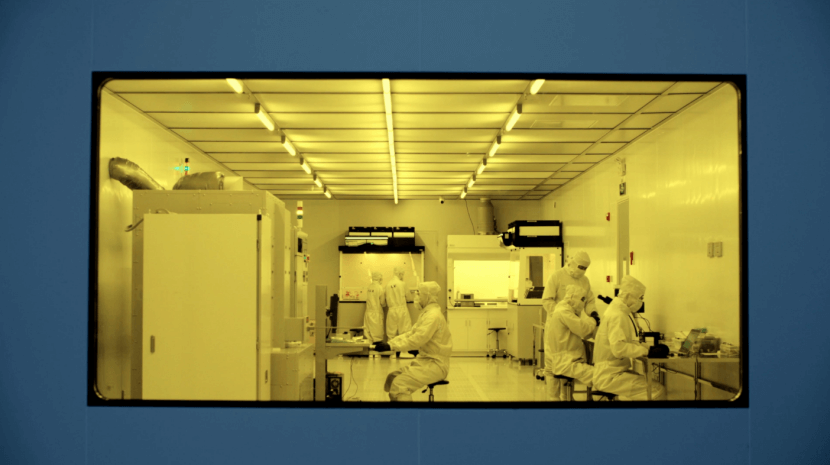
SpinQ has invested in a dedicated superconducting quantum chip foundry and standardized high‑volume workflows to deliver consistent, factory‑characterized QPUs. Each chip is accompanied by test reports that include qubit frequencies and decoherence times, giving users clear visibility into performance before integration. This level of control over fabrication is a major contributor to noise reduction and reliability.
If your team is exploring custom chip designs or foundry collaboration, you can learn more about SpinQ’squantum chip products and serviceshere:Superconducting Quantum Chips – QPU C Series.
Cryogenic and Shielding Techniques
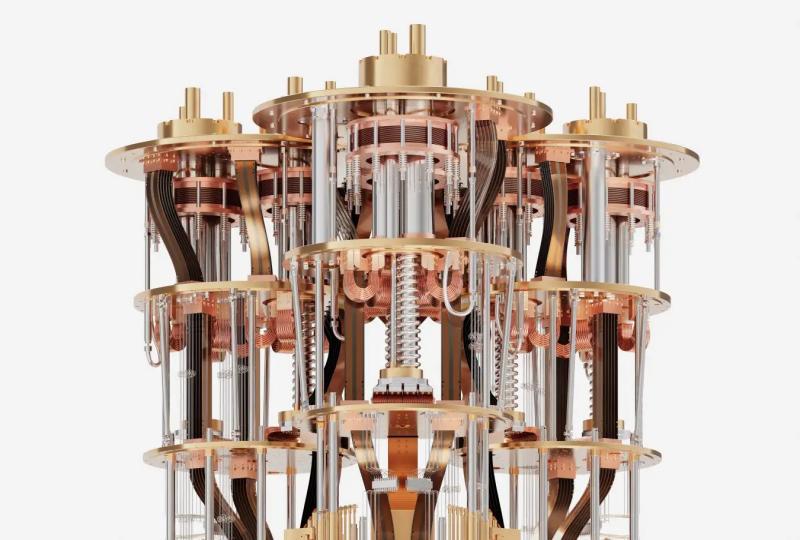
Because superconducting qubits operate at milli‑Kelvin temperatures, the cryogenic environment is central to noise reduction. Any stray heat or electromagnetic radiation entering the device can drive qubits out of their ground state or introduce phase errors.
Effective strategies at this layer include several well‑established methods.
-
Deep cryogenic cooling using dilution refrigerators to suppress thermal photons and achieve long coherence times.
-
Multi‑stage shielding and filtering along all microwave and DC lines to block external electromagnetic interference.
-
Careful mechanical design to mitigate vibrations that could modulate qubit frequencies or coupling strengths.
SpinQ’s SQC S Series superconducting quantum computers integrate the QPU, cryogenic system, shielding, and control electronics into unified platforms that are factory‑tuned for stability. By delivering a complete system rather than isolated components, we minimize integration‑related noise sources for our users.
.jpg)
Control Electronics, Calibration, and Software Mitigation
Even with strong physical isolation, noise can still enter a superconducting quantum chip through its control and readout channels. Imperfect microwave pulses or drifting calibration will degrade gate fidelity and reduce algorithm success rates.
State‑of‑the‑art control stacks use several complementary approaches to keep this under control.
-
High‑precision, low‑noise arbitrary waveform generators and readout electronics tailored for cryogenic operation.
-
Automated calibration routines that track qubit frequencies, pulse shapes, and crosstalk over time.
-
Software‑level error mitigation techniques that compensate for systematic biases and reduce the impact of residual noise on measurement outcomes.
SpinQ’s quantum control and measurement systems are designed as part of a full stack that includes QPUs, cryogenics, and software, ensuring that noise reduction is treated as a system‑wide goal rather than an afterthought. This integration allows users to focus on algorithm development and application research while relying on a stable hardware platform.
Quantum Error Correction as the Final Layer of Defense
Physical noise can never be completely eliminated, which is why quantum error correction (QEC) is a core requirement for practical quantum computing. Surface‑code architectures, in particular, spread logical information across many physical qubits so that local errors can be detected and corrected.
Next‑generation superconducting quantum chips from SpinQ are built with native support for surface‑code style QEC in mind. Enhanced 2D lattice connectivity and stable, high‑fidelity two‑qubit gates make it possible to explore surface‑code implementations with increasing code distances. This is essential for transitioning from noisy devices to fault‑tolerant quantum processors capable of running deep circuits.
By combining physical noise reduction with QEC‑ready architectures, SpinQ helps customers move toward truly scalable quantum computation rather than isolated demonstrations.
How SpinQ Helps You Tackle Superconducting Quantum Chip Noise
Noise reduction is a multidimensional challenge that spans chip design, fabrication, packaging, cryogenics, control electronics, calibration, and error correction. SpinQ addresses this challenge through a full‑stack approach that includes superconducting QPUs, integrated quantum computers, and comprehensive support services.
Whether you are building a quantum research lab, exploring quantum error correction, or developing early industry applications, SpinQ can provide tailored superconducting hardware and systems to match your needs. Our goal is to reduce the complexity of superconducting quantum chip noise reduction so that you can focus on the science and applications that matter most.
If you are also interested in education‑grade NMR platforms that complement your superconducting systems, you can explore ourNMR quantum products for teaching and training:NMR Quantum Products & Services.
Featured Content