
Quantum Mechanical Model: A Practical Guide for Modern Computing
2026.07.14 · Blog quantum mechanical model
1.Why the quantum mechanical model still matters
The term “quantum mechanical model” often sounds like something that belongs only in physics textbooks, far away from practical technology. Yet this model is the foundation of every modern quantum computer, from research‑grade superconducting processors to compact NMR‑based machines used in classrooms. Whenever we talk about qubits, superposition, or entanglement, we are using ideas that come directly from the quantum mechanical model of matter and energy.
For universities, research institutes, and companies exploring quantum computing, a clear grasp of this foundational model is more than academic. It shapes how devices are designed, how algorithms are developed, and how results are interpreted. Even if not every student or engineer needs to derive the theory from first principles, understanding the main concepts and how they connect to real hardware can dramatically improve the quality of quantum projects and the decisions made around them.
2.From classical models to the quantum mechanical model
Classical physics models particles and systems with definite positions, velocities, and energies. In this view, uncertainty arises mainly from lack of information or measurement limits. The quantum mechanical model, however, treats particles as quantum states described by wavefunctions or state vectors. These states can encode probabilities and interference patterns in a way that has no classical counterpart.
In the quantum mechanical model, systems are described in terms of discrete energy levels and operators that act on state vectors. Observables such as position, momentum, and spin correspond to these operators. Measurement does not simply reveal pre‑existing values; it affects the state itself. This perspective allows the model to explain phenomena like energy quantization, tunneling, and coherent superposition, all of which are vital for understanding how qubits behave inside quantum computers.
For quantum computing, the most relevant part of the quantum mechanical model is the description of two‑level systems. These systems are natural qubits. They can represent logical 0 and 1 via different energy levels, spin orientations, or other discrete quantum configurations. By modeling how these two‑level systems evolve under specific interactions, engineers and scientists can design qubits, gates, and measurement procedures that align with theoretical expectations.
3.Key concepts: superposition, operators, and measurement
Several core ideas from the quantum mechanical model directly drive how quantum computers operate. Superposition is the concept that a quantum state can be a linear combination of basis states. For a qubit, this means being in a combination of 0 and 1 with complex amplitudes. In hardware, this can correspond to a superposition of energy levels, spin states, or circuit configurations.
Operators, such as Hamiltonians and unitary transformations, describe how states change over time or under specific interactions. In quantum computing, gate operations are implemented as controlled unitary transformations that act on qubit states. The quantum mechanical model provides the mathematical framework for designing and analyzing these gates, ensuring they perform the intended rotations or entangling operations.
Measurement, within the quantum mechanical model, is not a passive activity. When you measure a quantum system, its state collapses into one of the possible eigenstates of the measurement operator. For qubits, this means that reading out a 0 or 1 changes the state. Quantum algorithms are built around this fact, arranging evolutions so that measurement outcomes reveal useful information about a problem. Without the measurement formalism from the quantum mechanical model, the logic of quantum algorithms would be impossible to articulate properly.
4.How the quantum mechanical model underpins real qubits
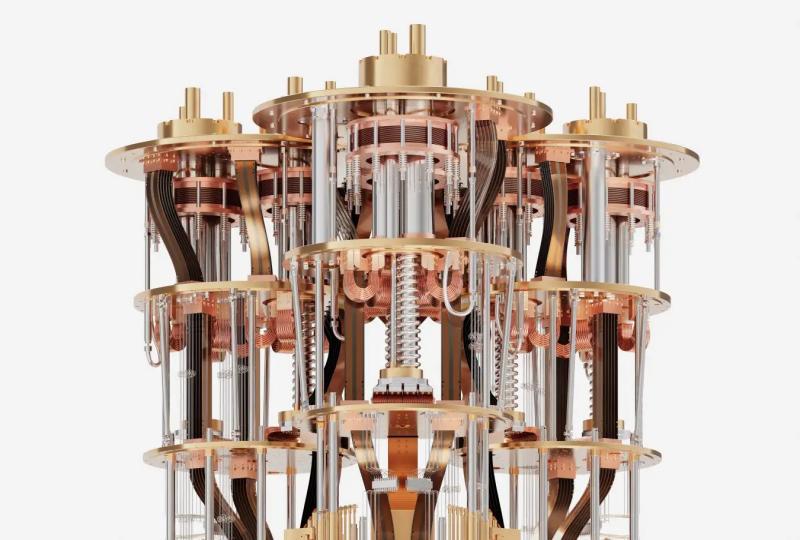
The quantum mechanical model is not just a theoretical curiosity; it is the blueprint used to design qubits in real hardware. In superconducting quantum computers, qubits are implemented as engineered circuits that behave like artificial atoms. The possible energy levels of these circuits and their transitions are calculated using quantum mechanical principles. Designers rely on these calculations to ensure the circuits have well‑defined energy gaps, controllable transitions, and minimal unwanted interactions.
In NMR‑based quantum computers, like SpinQ’s desktop systems, qubits are nuclear spins in molecules. The quantum mechanical model describes how these spins align with magnetic fields, how they precess, and how they respond to radiofrequency pulses. Pulse sequences used to implement gates are derived from this model, translating theoretical spin dynamics into practical control strategies.
Across platforms, the quantum mechanical model tells engineers which degrees of freedom can serve as qubits, how to control them cleanly, and where decoherence and noise are likely to appear. It guides the design of materials, interfaces, and circuits, making the difference between devices that behave as intended and ones that fall short.
5.Educational value: teaching the model with real hardware
For educators, the quantum mechanical model can be intimidating to present purely as equations on a board. Students often struggle to connect formalism with real systems. This is where compact quantum computers, such as SpinQ’s NMR‑based devices, become powerful teaching tools.
When students see the quantum mechanical model applied to an actual device, concepts such as state vectors, operators, and measurement take on concrete meaning. They learn that the Hamiltonian they see in a textbook corresponds to a real physical system in the lab, and that the gates they implement are specific unitary operations acting on those states. A well‑chosen NMR quantum computer kit allows instructors to move back and forth between theory and experiment, reinforcing the model with hands‑on data.
SpinQ’s products are built with this educational mission in mind. Our systems come with materials that tie theoretical concepts directly to experiments. Students can perform basic quantum mechanical model exercises—such as observing Rabi oscillations or interference patterns—and see data that confirm the predictions of the model. This connection helps demystify the theory and makes it more accessible to a broader range of learners.
6.The quantum mechanical model as a guide to cost and capability
The quantum mechanical model also influences how organizations think about the cost and capability of quantum hardware. Because the model governs coherence times, error mechanisms, and achievable gate operations, it effectively sets the performance envelope of any qubit system. Buyers who understand basic aspects of the model can make more informed decisions when evaluating different quantum technologies.
For example, the model explains why certain materials and configurations yield longer coherence or lower noise. It clarifies why some systems can sustain deeper circuits and more complex algorithms than others. When institutions consider purchasing an educational quantum computer or a research‑grade superconducting system, knowledge of the underlying model helps them interpret specifications—such as energy level structure, coupling strengths, or decoherence rates—in a meaningful way.
SpinQ leverages this understanding when designing and presenting its products. We communicate not only what our systems can do, but also how those capabilities arise from quantum mechanical principles. This transparency helps customers align expectations with reality and choose platforms that suit their goals in education, research, or early commercial exploration.
7.Looking ahead: the model as a durable foundation
Quantum technologies will evolve rapidly over the coming years, but the quantum mechanical model will remain the foundation that ties new developments together. Whether future advances come from improved superconducting circuits, novel materials, hybrid architectures, or better error correction, they will be built on the same basic principles of state vectors, operators, and measurement.
For organizations planning long‑term quantum strategies, investing in understanding and teaching the quantum mechanical model is a sound choice. It ensures that students, researchers, and engineers share a common language and conceptual frame, making it easier to adopt new hardware platforms or algorithms as they appear. SpinQ’s role is to provide hardware and solutions that make this model tangible—from NMR‑based classroom systems to more advanced superconducting offerings—so that theory and practice grow together.
Featured Content