
How a Quantum Computer Works: From Qubits to Real Devices
2026.08.12 · Blog how a quantum computer works
How a quantum computer works is fundamentally different from the way classical computers process information. Platforms like SpinQ’s NMR quantum computers are designed to make these principles tangible, turning abstract quantum mechanics into practical experiments for education and research.
What Is a Quantum Computer?
A quantum computer is a computing device that uses the laws of quantum mechanics to process information. Classical computers store data in bits that are either 0 or 1. Quantum computers use quantum bits, or qubits, that can be 0, 1, or any quantum superposition of both at the same time.
This difference gives quantum computers a unique advantage for certain problems. When multiple qubits are combined, their joint state can represent an enormous number of configurations simultaneously, which is promising for optimization, cryptography, and complex simulations that are difficult for classical machines.
For many learners, the biggest barrier to understanding how a quantum computer works is the lack of accessible hardware. Instead of relying only on simulations, institutions can use education-grade NMR quantum computers from SpinQ to give students hands-on experience with real qubits and quantum circuits in classroom and lab environments. The SpinQ quantum computer company site outlines how the brand positions its solutions for education, research, and industry.
How a Quantum Computer Processes Information
From Bits to Qubits
In a classical computer, bits take values 0 or 1 and are processed by transistors in logic circuits. A quantum computer replaces bits with qubits. A qubit can exist in state |0⟩, |1⟩, or a superposition of both. A simple analogy is a coin: a classical bit is like a coin lying flat as heads or tails; a qubit is like a spinning coin that embodies a mixture of heads and tails until it is observed.
With n qubits, a quantum computer can represent 2n2n basis states simultaneously. Quantum algorithms exploit this exponential state space by manipulating qubits in ways that amplify desirable outcomes and suppress undesirable ones.
Superposition, Entanglement and Interference
Three quantum phenomena enable quantum computers to work: superposition, entanglement, and interference.
-
Superposition allows qubits to occupy multiple states at the same time, so algorithms can explore many possibilities in parallel.
-
Entanglement creates strong correlations between qubits, enabling operations that link variables in ways classical bits cannot.
-
Interference lets probability amplitudes combine and cancel; quantum circuits are arranged so that correct answers receive constructive interference, while wrong answers are diminished.
Together, these effects define how a quantum computer works: prepare qubits in superposition, entangle them to encode relationships, apply quantum gates, and finally use interference and measurement to extract useful results.
The Basic Workflow of a Quantum Computation
A typical quantum computation follows three main steps: initialization, evolution via quantum gates, and measurement.
First, qubits are initialized in a known reference state, usually |0⟩ for all qubits. State preparation then uses specific sequences of quantum gates to create the superposed and entangled states required by the algorithm.
Quantum algorithms are expressed as quantum circuits: ordered sets of gates acting on qubits. Gates such as the Hadamard create superposition, while controlled operations like CNOT generate entanglement. The circuit structure determines how a quantum computer explores its state space and guides interference toward the correct solution.
At the end of the computation, qubits are measured. Measurement collapses the quantum state into classical outcomes: each qubit becomes 0 or 1, producing a bit string as output. Because measurement is probabilistic, quantum algorithms are designed so that correct answers appear with high probability. By running circuits multiple times and analyzing statistics, users can infer reliable results.
On SpinQ’s NMR-based systems, this workflow is realized physically: qubits are encoded in nuclear spin states, radiofrequency pulses implement quantum gates, and NMR signals carry the measurement information that students and researchers can analyze directly.
SpinQ’s NMR Quantum Computers in Practice
To move beyond theory, quantum concepts must be implemented in real hardware. Many leading platforms, such as superconducting and trapped-ion systems, require complex cryogenic or laser-based infrastructure. SpinQ focuses on nuclear magnetic resonance (NMR) quantum computers that are tailored for education and training.
In NMR quantum computing, qubits are realized as nuclear spin states within molecules under strong magnetic fields. Radiofrequency pulses control these spins, enabling state preparation, gate operations, and measurement via NMR signals.
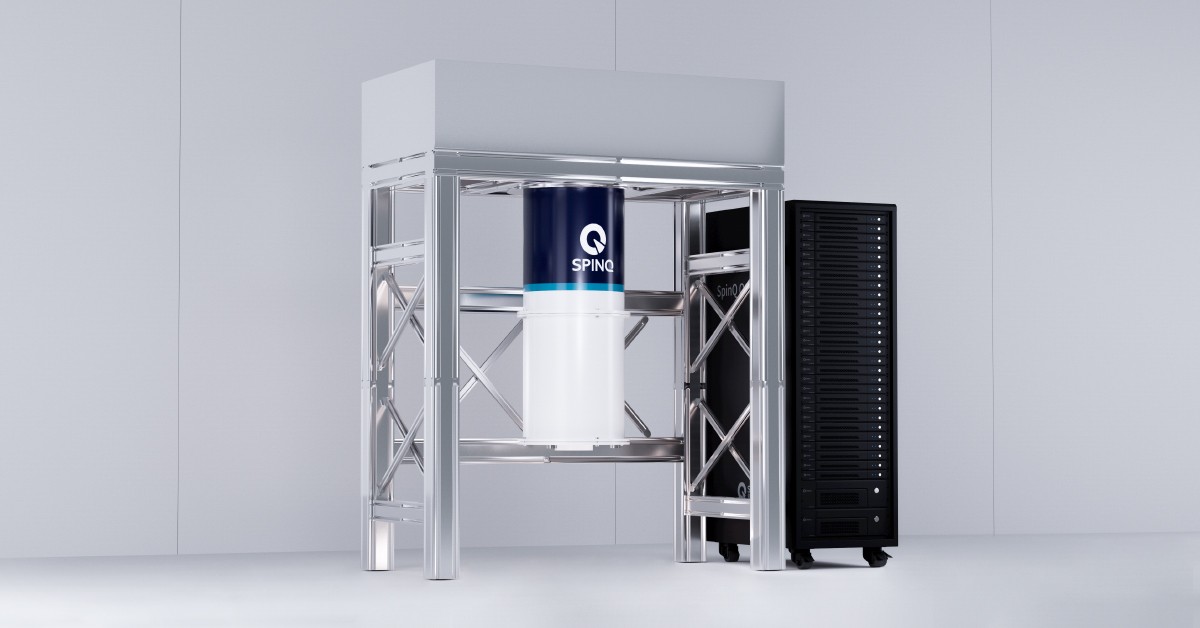
SpinQ offers education-grade NMR quantum computers that are affordable, maintenance-free, and available in desktop and portable configurations. These systems operate at or near room temperature, avoiding the extreme cooling requirements of many superconducting devices. This makes them especially suitable for universities, training centers, and labs that need practical access to real qubits without building a full cryogenic facility.
On a desktop NMR quantum computer, learners can implement quantum circuits, control state preparation and gate sequences, and analyze measurement statistics. This mirrors the theoretical workflow described above, giving students a concrete view of how a quantum computer works in practice and helping instructors connect abstract principles with hands-on experiments. More details about SpinQ’s desktop and portable devices are available on the education-grade NMR quantum computers page.
Future Challenges in Quantum Computing
Even as educational platforms make quantum computing more accessible, the field still faces major technical challenges. One critical issue is quantum decoherence—the loss of quantum information due to interactions with the environment. Qubits are highly sensitive to noise and imperfections, which cause errors and limit computation time.
Another challenge is scalability. Demonstrations with tens or hundreds of qubits are not enough for fault-tolerant, application-scale systems. Reaching thousands or millions of reliable qubits will require advances in hardware, control electronics, and error correction.
Current devices operate in the NISQ (Noisy Intermediate-Scale Quantum) regime, where errors are significant and full quantum error correction is still out of reach. In this context, robust, user-friendly platforms play an important role by supporting education and experimentation. SpinQ’s NMR quantum computers provide a stable environment where students and researchers can observe how real qubits behave, study coherence and noise, and build intuition for the engineering and algorithmic challenges ahead.
Featured Content