
Commercial-Grade Educational Quantum Computer Guide
2026.05.28 · Blog commercial-grade Educational Quantum Computer
A commercial-grade Educational Quantum Computer is no longer just a classroom demo device; it is a fully engineered platform that supports serious teaching, hands-on research, and entry-level industry exploration. Instead of fragile lab prototypes, educators and innovators can now deploy reliable, supported quantum systems that fit real budgets and real classrooms. This shift is transforming quantum education from theory-heavy courses into practice-driven programs that build job-ready skills.
What Does “Commercial-Grade Educational Quantum Computer” Mean?
In quantum computing, “commercial-grade” describes systems that are delivered as finished products with defined configurations, documentation, and technical support—not one-off research setups. When paired with “Educational Quantum Computer,” it refers to a system designed specifically for teaching and training, but built to commercial standards of reliability, usability, and lifecycle support.
These systems typically come as turn-key hardware plus an integrated software stack, often with cloud connectivity for remote access and curriculum resources. They are engineered to be installed in university labs, innovation classrooms, and training centers with clear guidance on operation, safety, and maintenance. Compared with lab-only prototypes, they emphasize predictable behavior, stable performance, and a smooth learning experience for non-expert users.
Why Educational Institutions Need Commercial-Grade Systems
Universities, vocational colleges, and even advanced high schools increasingly view quantum computing as a strategic discipline for talent development. However, many lack the infrastructure and specialist staffing to operate dilution-refrigerator-based superconducting machines or fully custom research platforms. A commercial-grade Educational Quantum Computer solves this gap by delivering a ready-to-use system that can be operated safely by trained instructors and students.
This approach shifts the focus from “keeping the hardware running” to “designing experiments and learning algorithms.” Students can run circuits, explore quantum gates, and experiment with algorithms without worrying about cryogenics or complex electronics. For administrators, predictable cost, vendor support, and integration with existing teaching infrastructure are equally important benefits.
Key Features of a Commercial-Grade Educational Quantum Computer
Although implementations differ, mature educational quantum systems share several core characteristics that distinguish them from simple simulators or toy devices.
-
Real quantum hardware Systems such as SpinQ’s education grade NMR quantum computers use physical qubits based on nuclear magnetic resonance, providing genuine quantum behavior at room temperature. Students interact with actual quantum states instead of purely classical emulators.
-
Turn-key, room-temperature operation Unlike cryogenic superconducting platforms, desktop NMR educational systems are designed for classroom environments, with no specialty cooling or high-vacuum systems required. This dramatically lowers operational complexity and cost for schools.
-
Integrated software and cloud services Commercial-grade Educational Quantum Computers are typically bundled with graphical circuit editors, QASM-like programming interfaces, and cloud platforms that connect to multiple quantum backends. This enables both beginners and advanced users to work at their preferred abstraction level.
-
Curriculum and teaching resources Vendors focused on education provide experiment manuals, lesson plans, and progressive learning paths that align with university and K12 objectives. This helps institutions launch or scale quantum courses without building all teaching content from scratch.
-
Professional support and lifecycle services Commercial-grade systems come with installation assistance, training, and ongoing technical support so that labs can stay productive over years, not just semesters. This lifecycle mindset is a key difference from DIY research rigs.
How These Systems Bridge Education and Research
Modern desktop quantum computers show that “educational” and “research-capable” are no longer mutually exclusive. Today’s commercial desktop devices, such as SpinQ’s Gemini and Triangulum series, are engineered as all-in-one experiment platforms that enable both teaching and foundational research.
Advanced users can access lower-level pulse controls to probe hardware behavior, while beginners start with visual circuit environments. This multi-layer design allows the same system to serve undergraduate courses, graduate research, and even industry pilot projects. In practice, many labs now use educational-grade hardware to prototype algorithms and workflows before scaling up to larger remote systems via the cloud.
Applications of Commercial-Grade Educational Quantum Computers
A commercial-grade Educational Quantum Computer supports a surprisingly broad range of use cases across academia and beyond.
-
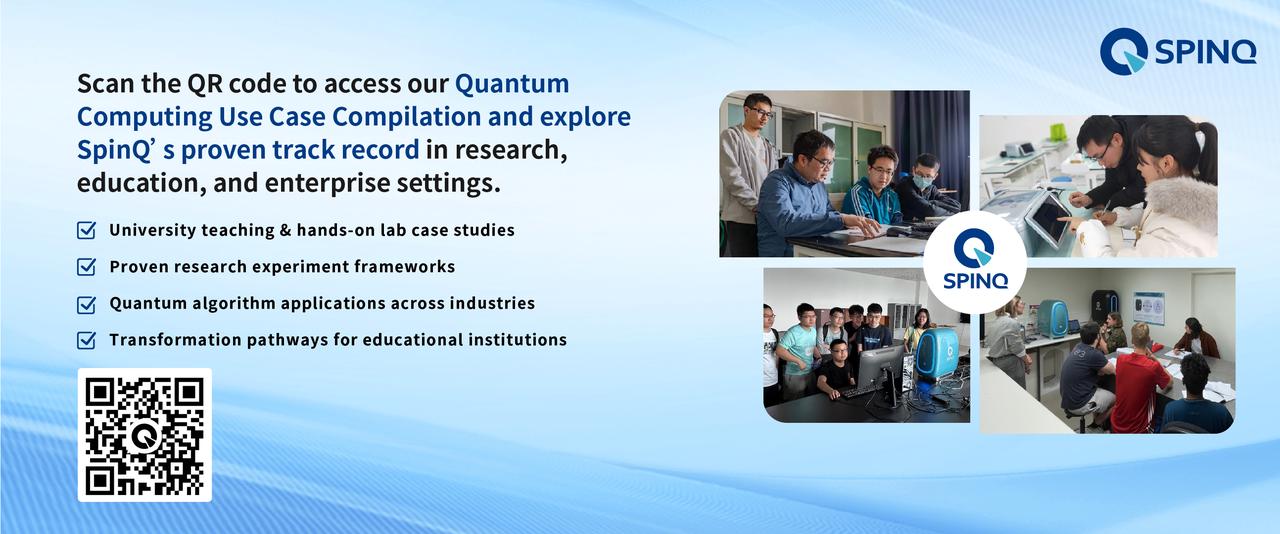
University and college teaching Institutions use these systems in introductory quantum computing courses, computer science curricula, and physics labs. Students learn quantum gates, circuits, and basic algorithms by running experiments on real hardware.
-
Research training and prototyping Research groups leverage educational systems to prototype new algorithms, test noise-mitigation techniques, and explore control strategies before moving to higher-qubit or cryogenic platforms.
-
K12 and outreach Portable, maintenance-free devices allow science museums, high schools, and outreach programs to introduce quantum concepts through hands-on demonstrations. This helps build a pipeline of future quantum professionals.
-
Workforce development and corporate training Companies upskilling their technical teams can pair educational quantum hardware with structured learning platforms to deliver practical, lab-like experiences without sending participants to specialized research facilities.
Technology Choices: NMR vs Superconducting in Education
When considering a commercial-grade Educational Quantum Computer, one of the biggest decisions is the underlying hardware technology. For education and small-scale research, NMR-based and room-temperature systems have significant advantages in cost, accessibility, and maintenance.
Superconducting quantum computers, on the other hand, dominate industrial and large-scale research systems and require cryogenic cooling, complex control electronics, and specialized facilities. For many first-time buyers—especially educational institutions—commercial-grade educational systems provide a more practical entry point, while cloud access or collaborations cover access to large superconducting platforms.
Cost Considerations for Educational Quantum Hardware
Budget is central to any educational technology decision. A key advantage of commercial-grade Educational Quantum Computers is that they significantly lower the cost barrier compared with full-scale superconducting installations.
Guides from SpinQ indicate that educational quantum systems can start from around a few thousand U.S. dollars, with typical educational and small-scale systems ranging from approximately 5,000 to tens of thousands of dollars depending on configuration and services. These systems are compact, room-temperature devices designed explicitly for teaching, basic experimentation, and entry-level research.
By contrast, enterprise-grade superconducting systems can reach multi-million-dollar price points once cryogenics, infrastructure, and staffing are included. For most schools and smaller research labs, educational-grade platforms therefore offer the best balance of cost, capability, and manageability.
How SpinQ Positions Its Educational Quantum Computers
SpinQ is widely recognized as a leading provider of both industrial-grade superconducting quantum computers and education-grade NMR quantum computers. Its educational hardware portfolio is explicitly designed to be low-cost, maintenance-free, and highly stable, making it suitable for long-term deployment in classrooms and labs.
The SpinQ Education Grade NMR quantum computer series includes multiple models—such as experimental, desktop, and portable versions—that address different teaching and research scenarios. These devices are integrated with SpinQ’s quantum cloud platform and software, which offer graphical circuit design, online QASM-style programming, user-defined quantum gates, and a library of built-in quantum algorithms.
Beyond hardware and software, SpinQ provides complete quantum education solutions, combining equipment, tailored classroom setups, and professional teaching teams. This one-stop approach helps universities, K12 schools, and science centers rapidly build or upgrade quantum education programs without piecing together tools from multiple vendors.
Planning and Buying a Commercial-Grade Educational Quantum Computer
For institutions considering their first commercial-grade Educational Quantum Computer, a structured buying process leads to better outcomes.
-
Clarify your primary objectives Decide whether your priority is undergraduate teaching, graduate research training, corporate upskilling, or outreach. This will influence the required qubit count, software tools, and support packages.
-
Match technology to use case Most educational environments benefit from room-temperature, compact systems like SpinQ’s NMR-based devices, which limit infrastructure needs. Cloud-based access to larger systems can complement these for advanced research.
-
Plan for curriculum integration Evaluate the vendor’s teaching resources, lab manuals, and training services to ensure that faculty can integrate the system into existing courses or build new ones efficiently.
-
Budget for total cost of ownership Consider not only the purchase price but also training, maintenance, and potential upgrades over a multi-year period. Educational-grade systems are explicitly designed to minimize ongoing overhead.
-
Choose a vendor with a full-stack vision Working with a provider like SpinQ that offers chips, full systems, education solutions, and cloud services gives you flexibility as your program grows.
The Strategic Value of Commercial-Grade Educational Quantum Computers
Commercial-grade Educational Quantum Computers are emerging as the most tangible and accessible layer of the quantum stack. They empower institutions to move from abstract lectures to authentic experimentation, and they create a natural bridge between academia and industry.
By investing in such systems, universities, schools, and training centers can cultivate quantum-literate talent, accelerate research readiness, and position themselves as leaders in a rapidly evolving field. With vendors like SpinQ providing integrated hardware, software, and education services, building a sustainable, impactful quantum education program has never been more achievable.
Featured Content